
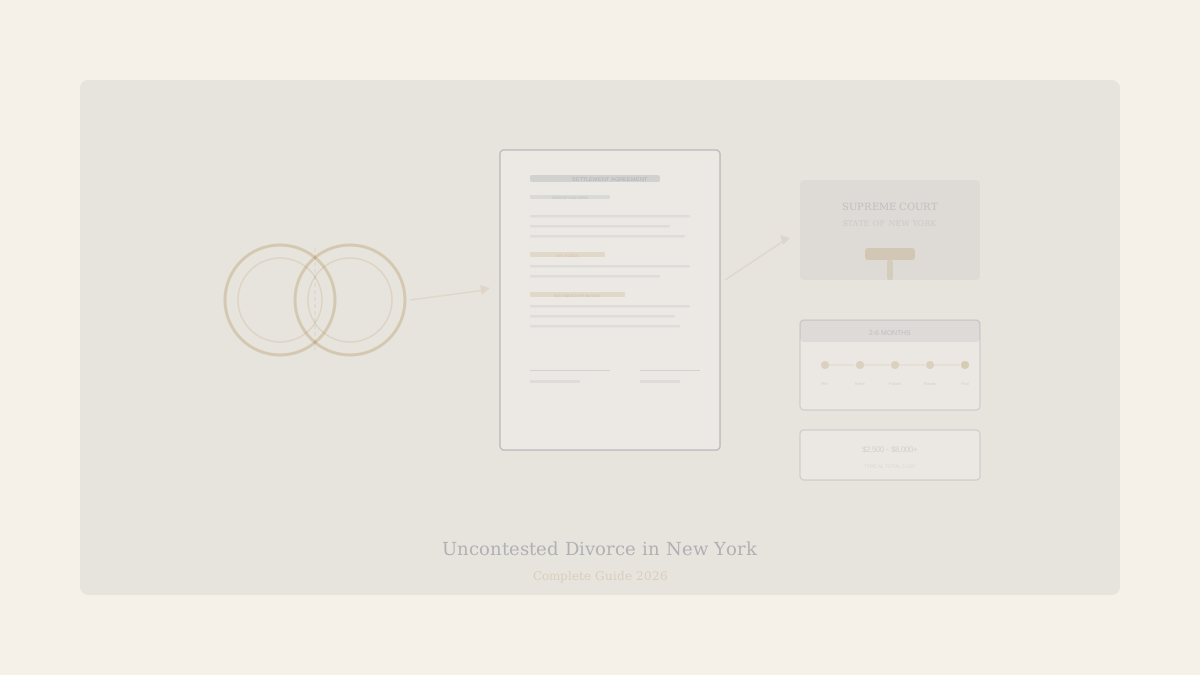
An uncontested divorce is, for most New York couples ending their marriage, the fastest and least expensive way through the legal process. When both spouses agree on the grounds for divorce and on every material term — distribution of property, debts, custody and visitation if children are involved, child support, and any spousal maintenance — the case can move through New York Supreme Court in two to six months at a total cost that is typically a small fraction of what a contested divorce costs. The procedural path is well-defined under New York’s Domestic Relations Law, and the typical case requires no court appearances.
This guide explains how uncontested divorce works in New York in 2026 — what makes a case eligible, the residency requirements under DRL § 230, the procedural steps from filing the Summons with Notice through the final Judgment of Divorce, the realistic timeline, what couples should expect to spend, and when an uncontested case is genuinely uncontested versus when it has hidden complexities that will derail it. It is written by a New York family law attorney for couples who are considering or actively pursuing an uncontested divorce, including individuals from the Iranian-American community who may also need to address mahr/mehrieh obligations alongside the divorce itself.
Not every couple who initially calls their divorce “uncontested” actually qualifies for the uncontested track. The most common reason an apparent uncontested case becomes contested is that one spouse later discovers an issue — typically related to financial disclosure, property characterization, or custody terms — that was not adequately addressed in the initial agreement. This guide explains both the typical path and the pitfalls that cause cases to derail.
What Makes a Divorce “Uncontested” in New York
Under New York practice, a divorce is “uncontested” when both spouses agree on every material term that the court would otherwise have to decide. This is not just about agreeing to get divorced — it means full agreement on all financial and child-related issues, captured in a written separation agreement or settlement agreement that is incorporated into the final divorce judgment.
The Three Conditions for an Uncontested Divorce
A case qualifies as uncontested only when all of the following are true:
- Both spouses agree on the grounds for divorce. In modern practice, this is almost always DRL § 170(7) — irretrievable breakdown of the relationship for at least six months.
- Both spouses agree on every financial term. This includes equitable distribution of marital property and debts, spousal maintenance (or its waiver), retirement asset division, debt allocation, and counsel fees.
- If there are children, both spouses agree on every child-related term. This includes legal custody, residential custody, parenting time and visitation schedule, child support amount (which must comply with the Child Support Standards Act under DRL § 240(1-b)), health insurance, childcare costs, educational expenses, and extracurricular expenses.
If any one of these conditions is not met — even on what seems like a minor issue — the divorce is contested as a matter of law, even if the spouses are otherwise on amicable terms.
What “Uncontested” Does NOT Mean
Several common misunderstandings about uncontested divorce deserve correction:
- “Uncontested” does not mean “no lawyers.” Most uncontested divorces involve at least one attorney drafting the settlement agreement and managing the filing. Many involve attorneys on both sides reviewing the agreement before signing.
- “Uncontested” does not mean “no judge involvement.” The divorce judgment is issued by a New York Supreme Court justice based on the submitted papers. The judge reviews the agreement and the papers for compliance with statutory requirements.
- “Uncontested” does not mean “no court fees.” Filing fees and court costs apply to uncontested cases just as they do to contested ones.
- “Uncontested” does not mean “no risk.” If the settlement agreement is poorly drafted, unenforceable provisions can surface years later, requiring expensive post-divorce litigation to unwind.
- “Uncontested” does not mean “fast in every county.” Court processing times vary by judicial district. New York County (Manhattan), Kings County (Brooklyn), and Queens County typically process uncontested divorces in two to four months. Some upstate counties can move faster.
Eligibility: Who Can File for Uncontested Divorce in New York
Before a New York court can grant any divorce — uncontested or contested — the case must satisfy the residency requirements under DRL § 230. Failure to meet residency is jurisdictional and cannot be waived by the parties’ agreement.
Residency Requirements Under DRL § 230
A New York court has jurisdiction over a divorce if any one of these conditions is met:
- The cause of action occurred in New York and both spouses were residents of New York at the time
- The cause of action occurred in New York and either spouse is a New York resident at the time the action is commenced
- The parties were married in New York and either spouse has been a New York resident for at least one continuous year before commencement
- The parties resided in New York as husband and wife and either spouse has been a New York resident for at least one continuous year before commencement
- Either spouse has been a New York resident for at least two continuous years before commencement (regardless of where the marriage occurred or where the parties lived together)
Most uncontested divorces filed in New York satisfy the residency requirement through one of the latter three categories. The New York Domestic Relations Law is the authoritative statutory source for all jurisdictional requirements.
Grounds: DRL § 170(7) Irretrievable Breakdown
New York added DRL § 170(7) — the no-fault ground — in 2010. Before then, an uncontested divorce required mutual agreement on a fault ground (cruel and inhuman treatment, abandonment, etc.) or a one-year separation under a written agreement. Today, virtually all uncontested divorces in New York are filed under DRL § 170(7) — irretrievable breakdown of the relationship for at least six months.
The filing spouse simply attests under oath that the marriage has been irretrievably broken for at least six months. The other spouse, by signing the settlement agreement and the related filing documents, effectively consents. DRL § 170(7) does not require that the parties live apart for six months. The “six month” period refers to the duration of the irretrievable breakdown, which can have occurred while the spouses continued to share a household.
The Uncontested Divorce Process: Step by Step
Once the parties have a fully executed settlement agreement, the uncontested divorce process moves through a defined sequence of filings in New York Supreme Court. The procedural mechanics differ slightly by county, but the structure is statewide. The New York State Unified Court System provides the official forms used in uncontested divorce filings.
Step 1 — Settlement Agreement (Pre-Filing)
The settlement agreement is the foundational document of any uncontested divorce. It is the written contract between the spouses that resolves every material issue in the marriage and is ultimately incorporated into the Judgment of Divorce. A comprehensive New York divorce settlement agreement must include:
- Identification of the parties and the marriage (date, location)
- Recitation of grounds (DRL § 170(7) irretrievable breakdown)
- Equitable distribution of all marital assets — real property, retirement accounts, bank accounts, investments, businesses, personal property
- Allocation of marital debts
- Spousal maintenance (amount, duration, modifiability — or waiver, with statutory acknowledgment that maintenance is being waived)
- For couples with children: legal custody, residential custody, parenting time schedule, decision-making allocation, child support (CSSA basic formula amount and add-on expenses), health insurance coverage, childcare costs, educational expenses
- Tax filing status and treatment of joint returns
- Provisions for QDRO preparation if retirement accounts are being divided
- Provisions for refinancing or sale of jointly-titled real property
- Mutual general release language
- Notarization and execution requirements
The quality of the settlement agreement determines whether the case proceeds smoothly or is returned by the court with a deficiency letter. This is the stage where competent legal drafting has the highest impact on outcome.
Step 2 — Purchase the Index Number
The case is initiated by purchasing an Index Number from the County Clerk in the county where the action will be filed. The current Index Number fee is approximately $210. Verify the current fee at nycourts.gov before filing, as court fees are adjusted periodically.
Step 3 — File the Summons with Notice
The plaintiff (the spouse filing the action) files either a Summons with Notice — a simpler one-page filing that states the action and the relief sought — or a Summons and Verified Complaint, which includes the substantive allegations. Most uncontested divorces in New York use the Summons with Notice because the substantive terms are addressed in the settlement agreement rather than the complaint.
Step 4 — Service or Affidavit of Defendant’s Appearance
The defendant (the non-filing spouse) must either be served with the Summons or sign an Affidavit of Defendant’s Appearance acknowledging receipt and waiving formal service. In an uncontested divorce, the defendant typically signs the Affidavit of Defendant’s Appearance simultaneously with the settlement agreement, eliminating the need for formal service. This is a critical efficiency in uncontested practice.
Step 5 — Prepare and File the Uncontested Divorce Packet
The plaintiff prepares the uncontested divorce packet, which typically includes:
- Note of Issue
- Affidavit of Plaintiff
- Affidavit of Defendant
- Affidavit of Regularity (or attorney affirmation)
- Sworn statement of removal of barriers to remarriage (if applicable, under DRL § 253)
- Settlement Agreement
- Findings of Fact and Conclusions of Law (proposed)
- Judgment of Divorce (proposed)
- Child Support Worksheet (if children)
- Notice of Entry
- Various certifications and supporting affidavits
The packet is filed with the County Clerk and forwarded to the assigned matrimonial judge.
Step 6 — Judicial Review and Entry of Judgment
The judge reviews the packet for completeness and compliance with statutory requirements. The judge may sign the proposed Judgment of Divorce and enter the divorce, issue a deficiency letter requesting corrections or additional documents, or decline to sign if the settlement agreement contains unenforceable provisions or unwaivable rights (for example, child support below the CSSA basic formula without proper written reasons for the deviation). Once the Judgment of Divorce is signed and entered, the divorce is final. The parties receive a certified copy and the marriage is legally dissolved.
Realistic Timeline for an Uncontested Divorce in New York
Total time from initial consultation to final Judgment of Divorce in a typical uncontested case ranges from two to six months. The timeline depends on the complexity of the settlement agreement, the county of filing, and how quickly both parties execute documents. For a more detailed discussion of how long divorce takes in New York across both contested and uncontested tracks, see our dedicated post on the topic.
A typical breakdown for an uncontested case:
- Settlement agreement drafting: 2–4 weeks (longer for cases involving businesses, retirement assets, or international issues)
- Agreement review and execution by both parties: 1–3 weeks
- Filing of Summons and Affidavit of Defendant’s Appearance: 1–2 weeks
- Preparation of uncontested divorce packet: 1–2 weeks
- Court processing time (varies by county): 6–12 weeks
- Total: typically 2–6 months
Counties with the highest matrimonial filing volumes — New York County, Kings County, Queens County, Bronx County, Nassau County, Suffolk County — typically take longer than smaller counties. Some couples who are flexible on filing venue can shave weeks off the timeline by filing in a less congested county where one of them maintains residency.
Costs: What an Uncontested Divorce Actually Costs in New York in 2026
Court Costs (Mandatory)
Court filing fees are non-negotiable and paid directly to the court:
- Index Number: approximately $210
- Request for Judicial Intervention (RJI): approximately $95
- Note of Issue: approximately $30
- Certified copy of judgment: approximately $8 per copy
Total court costs typically run $345–$400. Verify all current fees at nycourts.gov before filing.
Attorney Fees
In the New York market, attorney fees for uncontested divorce vary significantly based on case complexity:
- Simple case (no children, no real property, no retirement assets): $1,500–$3,000 flat fee
- Standard case (children, modest property division): $2,500–$5,000 flat fee
- Complex case (business interests, significant retirement assets, complex custody): $4,000–$8,000+ flat fee
Most uncontested divorces are handled on a flat-fee basis. Flat-fee transparency is one of the genuine advantages of choosing an uncontested track and a firm that practices in this area regularly. Document preparation services (non-attorney) are available at lower cost but are legally risky and not recommended for any case involving children, real property, or retirement assets.
Other Costs
Additional costs that may apply depending on the case:
- Process server fees (if formal service is required): $50–$150
- QDRO preparation for retirement asset division: $400–$1,500 per plan
- Real estate deed transfer and recording fees (if the marital home is being transferred)
- Translation and notarization fees (for documents in languages other than English)
When an “Uncontested” Divorce Is Actually Contested
This is one of the most common reasons cases fail, and it deserves direct discussion. Common scenarios where an apparently uncontested divorce becomes contested:
- One spouse later discovers undisclosed assets — hidden bank accounts, business interests, retirement plans, or real estate holdings
- The proposed child support amount deviates from the CSSA basic formula without compliant statutory reasons
- The proposed custody arrangement is not actually in the child’s best interests (the court has independent authority to scrutinize custody under DRL § 240)
- Spousal maintenance is being waived without statutory acknowledgment language
- One spouse signs the agreement under duress, coercion, or significant misunderstanding of its terms
- The agreement attempts to waive child support, which is not legally waivable
- One spouse changes their mind during the court processing period and withdraws consent
If any of these issues surfaces, the case must be re-filed as a contested action, which typically increases total cost by 5–10x and extends the timeline by 12–24 months. The cost of thorough settlement agreement drafting is insurance against this outcome.
Special Considerations for Couples with Children
When the marriage produces children, uncontested divorce remains possible but requires more substantive negotiation and more careful drafting. New York courts apply heightened scrutiny to child-related provisions because children are not parties to the agreement and cannot waive their rights.
The settlement agreement must address the best interests of the child standard under DRL § 240, which governs all custody and visitation determinations. Legal custody (decision-making authority over education, health, and religion) and residential custody (where the child lives) must both be addressed explicitly. A detailed parenting time schedule is required — covering the regular weekly schedule, holidays, school breaks, and summer.
Child support must be calculated under the Child Support Standards Act (CSSA) basic formula. The NY Office of Temporary and Disability Assistance publishes the current child support standards chart. Any deviation from the formula requires written reasons that comply with DRL § 240(1-b), and the judge has independent authority to reject a deviation that is not in the child’s best interests. The agreement should also address health insurance, unreimbursed medical expenses, childcare costs, extracurricular activities, and provisions for college expenses (New York does not impose a college contribution obligation absent agreement, but many couples choose to address it).
Provisions for relocation by either parent are increasingly important. A well-drafted agreement includes a framework for how relocation requests will be handled, reducing the likelihood of post-divorce motion practice on this issue.
Special Considerations for the Iranian-American Community
Couples in the Iranian-American community sometimes have considerations that general-practice family lawyers do not routinely address. The most significant is the mahr/mehrieh obligation from the Iranian marriage contract (aghd-nameh). Mahr is enforceable in New York as a contractual obligation, and it must be addressed in the divorce settlement agreement to avoid post-divorce litigation. The settlement should specify whether the mahr is being paid as part of equitable distribution, deferred with payment terms, or waived with appropriate consideration.
Other considerations include coordination with Iranian or Iranian consular procedures for divorces involving an Iranian-citizen spouse or property in Iran, cultural dynamics around extended family involvement and custody, and translation and notarization requirements for documents that must be filed or recognized in Iran. Couples with these considerations benefit from working with a New York attorney who handles them regularly rather than treating them as outside the scope of the matrimonial action. Our firm offers representation in English and Farsi.
When to Hire a NY Uncontested Divorce Attorney
Uncontested divorce in New York is legally possible without an attorney, but practically very difficult to execute well without one. The risks of self-filing include settlement agreement provisions that fail to comply with statutory requirements (which a judge will reject), inadequate financial disclosure that creates post-divorce litigation exposure, incomplete or improperly executed filings that cause the case to be returned for corrections, and settlement provisions that are ambiguous and become the subject of disputes years later.
For most couples, the cost of competent flat-fee representation ($2,000–$5,000) is significantly less than the cost of fixing problems after the fact — which can run $10,000–$50,000+ in contested post-divorce motion practice.
The cases where self-filing is most feasible: no children, no real property, no retirement assets, short marriages under five years, and both parties with separate, stable incomes and well-documented assets. The cases where attorney representation is functionally essential: children of any age, marital real property, retirement assets requiring QDRO division, business interests, marriages over ten years where maintenance analysis is significant, international elements, and any cultural or religious contract obligations such as mahr/mehrieh or ketubah.
Our matrimonial practice offers flat-fee representation for uncontested divorces structured around the complexity of the case. The attorneys at Yazdi Law handle cases across the five boroughs and surrounding counties, including cases involving prenuptial and postnuptial agreements that affect the equitable distribution analysis.