
For someone who cannot safely return home, asylum is the most consequential application in American immigration law: it protects you from removal, authorizes you to work, opens a path to a green card and citizenship, and lets you petition for your spouse and children. It is also a case you generally get one chance to present well — built on a deadline many applicants don’t learn about until it has nearly passed.
New York is one of the busiest asylum jurisdictions in the country. Its immigration courts at 26 Federal Plaza and 290 Broadway carry enormous dockets, its communities include asylum seekers from Iran, Afghanistan, China, Venezuela, West Africa, and dozens of other countries, and the difference between a granted case and a denied one here very often comes down to preparation. This guide explains how asylum actually works — the deadline, the two tracks, the evidence that wins, the work permit, and what to do at each stage. For the firm’s representation in these cases, see our asylum and asylum appeals practice page.
First Things First: The One-Year Deadline
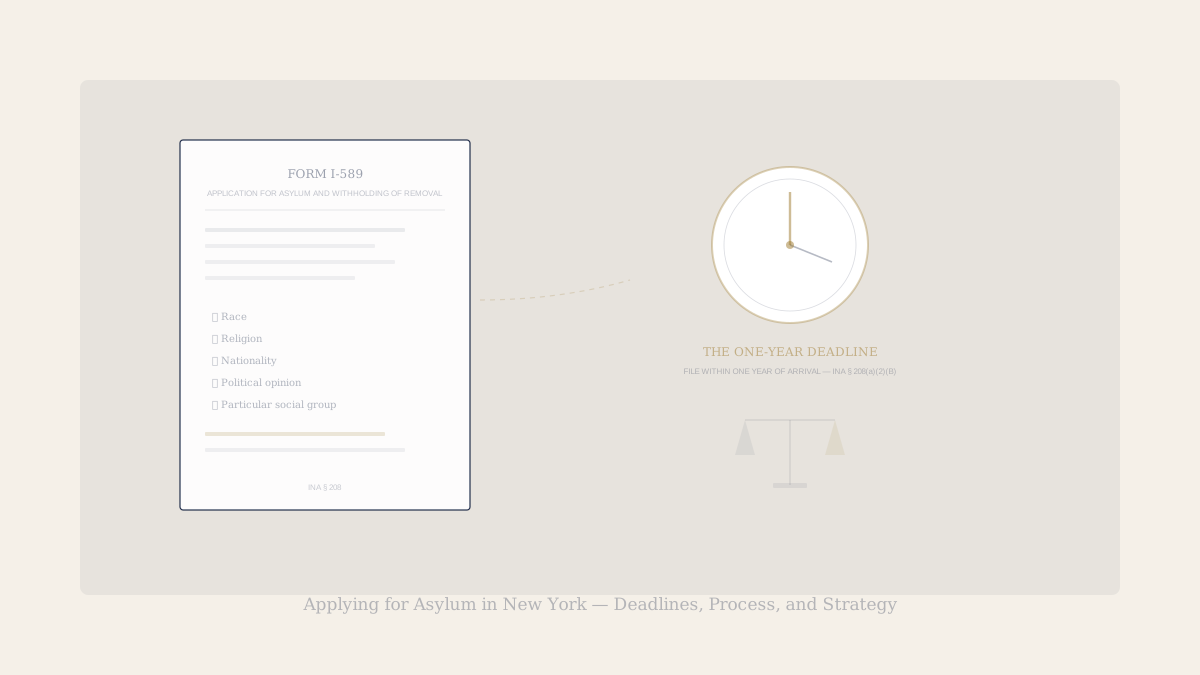
Under INA § 208(a)(2)(B), an asylum application must be filed within one year of your last arrival in the United States. This is the single most important fact in asylum law, and the most common way strong cases are lost before they begin. People arrive on visitor or student visas, hope conditions at home will improve, wait — and discover the bar only after the year has run.
Missing the deadline is not always fatal. Two statutory exceptions exist:
- Changed circumstances that materially affect eligibility — conditions in your country deteriorated, a new regime targeted your group, you converted to a persecuted faith, your political activities in the U.S. became known to your government, or you aged out of derivative status on a parent’s application
- Extraordinary circumstances that caused the delay — serious illness or disability, the ineffective assistance of a prior attorney or “consultant,” or maintaining lawful status during the period — provided you filed within a reasonable time once the circumstance passed
Both exceptions are fact-intensive and must be proven, not asserted. And even where no exception fits, late applicants may still pursue withholding of removal and Convention Against Torture (CAT) protection, which have no deadline but demand a higher likelihood of harm and confer narrower benefits. If you are inside your first year, file before it closes. If you are past it, see an attorney now — the exception analysis only gets harder with time.
What Asylum Requires: The Five Protected Grounds
Asylum is available to anyone who meets the refugee definition in INA § 101(a)(42): persecution or a well-founded fear of persecution on account of race, religion, nationality, political opinion, or membership in a particular social group.
Three concepts decide most cases:
Persecution means serious harm — threats to life or freedom, detention, torture, severe violence, or an accumulation of discrimination and harassment rising to that level — inflicted by the government or by forces the government is unable or unwilling to control. Harm from private actors (gangs, militias, abusive family members) can qualify where the state fails to protect.
Well-founded fear is a forgiving standard. In INS v. Cardoza-Fonseca, the Supreme Court recognized that even a 10% chance of persecution can make a fear well-founded. An applicant who proves past persecution gains a legal presumption of future persecution that the government must rebut.
Nexus is the causal link: the persecutor must target you because of the protected ground. This is where cases are most often lost — generalized violence or personal vendettas, without connection to who you are or what you believe, do not qualify. Framing the claim correctly at the outset — political opinion? religion? a cognizable particular social group, such as family membership, LGBTQ identity, or survivors of domestic violence in certain countries — is the most consequential legal decision in the case, and the clearest place where experienced counsel changes outcomes.
Two Tracks: Affirmative and Defensive Asylum
The Affirmative Track — USCIS
If you are not in removal proceedings, you apply affirmatively: file the Form I-589 (no filing fee) with USCIS, attend biometrics, and eventually appear for a non-adversarial interview with an asylum officer. You bring your own interpreter if needed; your attorney attends. The officer tests your story against your declaration and documents, then grants the case, or — if you lack other lawful status — refers it to immigration court. A referral is not a denial: it is a second, fuller opportunity before a judge.
The Defensive Track — Immigration Court
If you are in removal proceedings — because you were referred, were apprehended at or after entry, or overstayed and were placed in proceedings — asylum becomes your defense. The case is heard in New York’s immigration courts, where a government attorney cross-examines you at an individual merits hearing before an immigration judge. New York’s dockets are among the largest in the nation, and merits hearings are routinely scheduled years out. Our deportation defense practice covers this posture in depth.
The strategic rule that unifies both tracks: prepare every case as if it will be tried. The affirmative interview may be non-adversarial, but the declaration you file with USCIS will follow you into court if the case is referred — and any inconsistency between the two will be the government’s first exhibit.
The Evidence That Wins Asylum Cases
By statute, credible testimony alone can sustain an asylum claim. In practice, corroboration separates grants from denials. A well-built case file contains:
- The declaration — a detailed, chronological, first-person account of who you are, what happened, and why. It is the single most important document in the case: every interview and hearing will be measured against it. It must be complete, accurate, and written once, correctly
- Identity and nexus documents — passports, national ID, party membership cards, baptism or conversion records, press credentials, organizational letters
- Country condition evidence — State Department human rights reports, UNHCR guidance, Human Rights Watch and Amnesty documentation, and news reporting tied to your specific profile, not just general turmoil
- Medical and psychological evaluations — forensic documentation of scars and injuries, and psychological evaluations documenting PTSD and trauma, which both corroborate past harm and explain memory gaps that officers might otherwise read as evasion
- Witness statements — affidavits from family, co-religionists, fellow activists, or others with first-hand knowledge, in their own words
- Expert testimony — country condition experts in contested court cases
For applicants from countries with no U.S. diplomatic presence — Iranians most prominently — document authentication follows special channels, and the firm’s experience with Iranian civil documents, detailed on our Iranian attorney page, carries over directly into asylum practice.
Credibility: The Heart of Every Case
Under the REAL ID Act, adjudicators may weigh demeanor, plausibility, and consistency — including consistency on matters that do not go to the heart of the claim. In plain terms: the smallest contradictions can sink the strongest cases. A date that shifts between the declaration and testimony, a detail added years later at the hearing, an answer that conflicts with a visa application filled out long ago — each becomes a thread the government attorney pulls.
Preparation is the antidote. Well-handled cases involve multiple preparation sessions, in the client’s own language, rehearsing direct testimony and hostile cross-examination; review of every prior statement ever made to the U.S. government; and honest treatment of trauma — because “I don’t remember” from a torture survivor, supported by a psychological evaluation, is credible, while a confident guess that contradicts the declaration is fatal.
The Work Permit: Surviving the Wait
Asylum seekers cannot work immediately — but they do not wait forever. Once the I-589 has been pending 150 days, you may file Form I-765 for an Employment Authorization Document, which USCIS may grant once the “asylum clock” reaches 180 days. Applicant-caused delays stop the clock, so scheduling decisions in the case should always be made with the clock in mind. The EAD renews for as long as the case — including appeals — remains pending, and it brings a Social Security number with it. For families facing a multi-year wait in New York’s backlog, getting the filing done promptly and the clock running is often as urgent a priority as the merits themselves.
After the Grant — and After a Denial
If asylum is granted: you may remain and work indefinitely, petition for your spouse and unmarried children under 21 (Form I-730), travel on a refugee travel document (returning to the country of persecution is dangerous to your status and should be discussed with counsel first), and apply for a green card one year after the grant — with naturalization typically available four years after that.
If the case is denied: the fight continues on appeal. An immigration judge’s denial may be appealed to the Board of Immigration Appeals within 30 days, and the BIA’s decision may be challenged by petition for review in the U.S. Court of Appeals for the Second Circuit. Appeals are won on the record made below — the declaration, the exhibits, the testimony — which is the final reason the case must be built properly the first time. Yazdi Law’s immigration team includes Of Counsel admitted before the Second Circuit, allowing the firm to carry a case from the first filing through federal court review.
Why Asylum Seekers in New York Choose Yazdi Law
Asylum is the most personal case in immigration law — it requires telling the worst moments of your life to a stranger, in detail, under oath. The firm’s approach is built around that reality:
- Language and trust. Consultations and case preparation in Farsi and Punjabi as well as English — directly with the attorneys, not through intermediaries. For clients with family still in their home country, confidentiality protocols are discussed at the first meeting
- Full-spectrum representation. From the one-year deadline analysis and I-589 preparation through the asylum interview, immigration court, the BIA, and the Second Circuit — one firm, one strategy, one case file built for trial from day one
- Experience with hard-country documentation — including Iranian cases where no U.S. embassy exists and civil documents require third-country authentication
- Related relief. Where the facts support it, the firm evaluates parallel paths — TPS and VAWA, family petitions, and other options that can protect you if asylum’s requirements cannot be met
Talk to a New York Asylum Attorney — in Your Language
If you fear returning to your country, two clocks may already be running: the one-year filing deadline and the 180-day work permit clock. Both reward acting now. Yazdi Law represents asylum seekers throughout New York City and the surrounding counties from our office at 261 Madison Avenue in Midtown Manhattan — affirmative applications, defensive cases in immigration court, and appeals.
Call (917) 565-7286 or use the form below for a free, confidential consultation in English, Farsi, or Punjabi. We will tell you honestly whether you have a case, what it needs, and what it will take to win it.