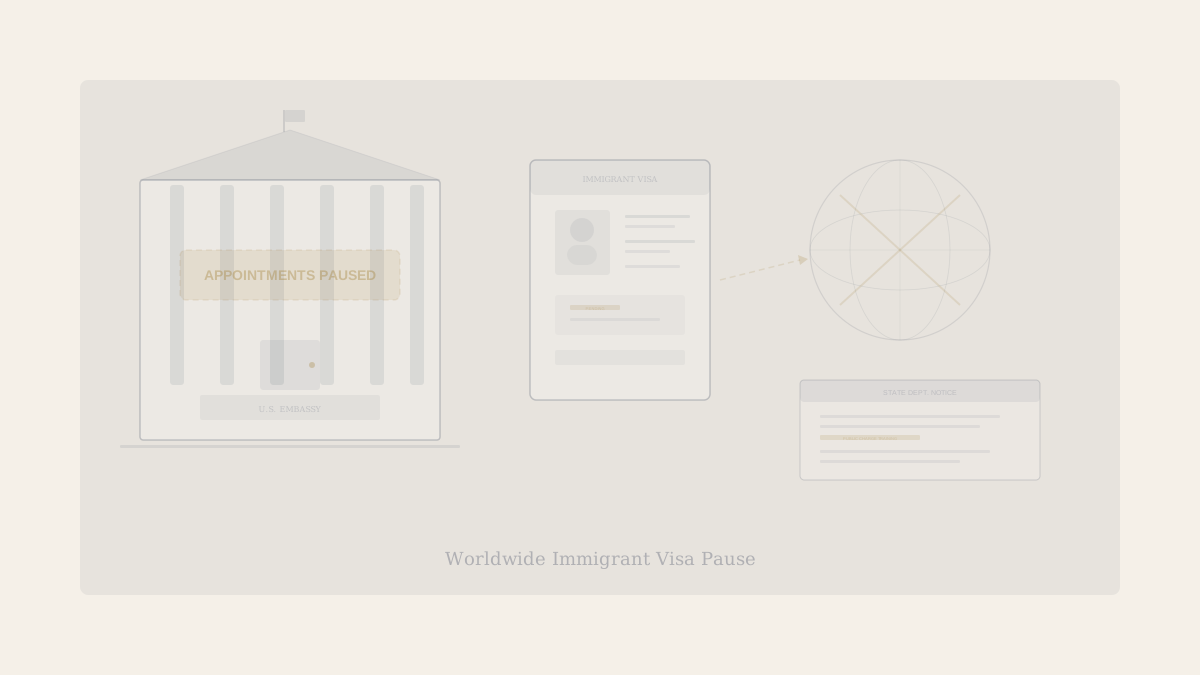
On August 25, 2026, the U.S. Department of State directed all U.S. embassies and consulates worldwide to pause immigrant visa appointments while consular officers undergo training on expanded public charge screening requirements. Applicants who had interviews scheduled — many of whom have waited months or years, completed medical examinations, and spent thousands of dollars in preparation — received emails stating their appointments are postponed with no new date provided.
The pause affects an estimated 200,000 immigrant visa applicants globally, including family-based, employment-based, and diversity visa applicants processing through U.S. consulates abroad. The State Department has not announced when normal scheduling will resume.
This post explains what happened, who is affected, what the public charge training means, and what applicants should do while their cases are on hold. If your immigrant visa interview has been postponed, an immigration attorney can evaluate whether alternative processing options are available to you.
This post is based on information available as of August 26, 2026. The situation is developing and may change. This is general legal information, not legal advice for any specific case.
What Happened: The Worldwide Visa Appointment Pause
The State Department launched what it describes as an “in-depth training” program at all U.S. embassies and consulates in early August 2026. The training focuses on how consular officers evaluate whether an immigrant visa applicant is likely to become a public charge — meaning someone who is primarily dependent on government assistance — after being admitted to the United States.
To accommodate the training, the State Department directed consular posts to reschedule immigrant visa interviews. Applicants received email notifications that their appointments were postponed, with new dates to be communicated later. The notices did not provide a timeline for when the training would be completed or when interviews would resume.
The pause applies to immigrant visa interviews at U.S. consulates and embassies abroad. It does not cancel visas that have already been issued, and it does not directly affect applicants who are adjusting status inside the United States through USCIS (Form I-485). Nonimmigrant visa appointments may also be affected at some posts due to scheduling adjustments, though the pause is primarily directed at immigrant visa processing.
Why This Is Happening: Public Charge, the 75-Country Ban, and the New Training
The pause is part of a broader tightening of immigration screening under the current administration. To understand the context, three developments are relevant:
The Public Charge Ground of Inadmissibility
Under the Immigration and Nationality Act (INA § 212(a)(4)), an immigrant visa applicant may be found inadmissible if the consular officer determines that the applicant is “likely at any time to become a public charge.” Consular officers evaluate factors including the applicant’s age, health, income, education, skills, family status, and the financial resources of the petitioning sponsor (as documented on Form I-864, the Affidavit of Support). The public charge ground has existed for over a century but has been applied with varying degrees of strictness across administrations.
The current administration has expanded the definition of public charge and directed consular officers to apply it more aggressively. The training program now underway is designed to implement these expanded screening criteria consistently across all consular posts worldwide.
The 75-Country Suspension and Its Vacatur
On January 15, 2026, the State Department suspended immigrant visa processing for nationals of 75 countries whose populations the administration determined were at high risk of becoming public charges. The suspension affected countries across Africa, Asia, the Middle East, and Central America, including Afghanistan, Iran, Iraq, Syria, Haiti, Ethiopia, and dozens of others.
On August 22, 2026 — just three days before the worldwide pause was announced — U.S. District Judge Jeannette Vargas vacated the 75-country suspension, ruling that Secretary of State Marco Rubio exceeded his statutory authority by issuing a blanket country-based suspension rather than conducting individual case-by-case adjudications as the INA requires. Judge Vargas found the policy “contrary to law and in excess of statutory authority.”
The timing is significant. Within days of a federal court striking down the country-specific suspension, the administration implemented a worldwide pause that achieves a similar practical effect — halting immigrant visa processing — under a different justification: officer training. Whether this is a coincidence or a deliberate workaround is a matter of public debate, but the practical result for applicants is the same: interviews are not happening.
The Public Charge Bond Pilot Program
On August 5, 2026, the State Department announced a Public Charge Bond Pilot Program. Under this program, a consular officer who finds an applicant inadmissible on public charge grounds may direct the applicant to post a bond of up to $250,000 with USCIS. If the bond is approved and posted, the consular officer may issue the visa. The bond is forfeited if the immigrant uses certain public benefits within a specified period after admission.
The bond pilot is separate from the training pause, but the two are connected: the training is reportedly preparing consular officers to apply the expanded public charge criteria that the bond program operationalizes. Applicants should anticipate that when interviews resume, public charge scrutiny will be substantially more rigorous than it was before the pause.
Who Is Affected
The pause affects all categories of immigrant visa applicants who are processing through U.S. consulates abroad:
- Family-based applicants — spouses, parents, children, and siblings of U.S. citizens and lawful permanent residents who are processing through an I-130 petition and awaiting a consular interview
- Employment-based applicants — workers with approved I-140 petitions whose priority dates are current and who are scheduled for consular processing
- Diversity visa (DV lottery) applicants — winners of the DV lottery who must complete processing before the end of the fiscal year (September 30, 2026). This group faces the most acute harm because DV visas cannot be carried over to the next fiscal year
- Other immigrant visa categories — including special immigrant visas (SIVs) for Afghan and Iraqi interpreters, returning residents, and other categories processed at consular posts
The pause does not directly affect:
- Adjustment of status applicants — individuals inside the United States who have filed Form I-485 with USCIS to adjust to permanent resident status. These cases are adjudicated by USCIS, not by consular officers
- Already-issued visas — immigrant visas that have already been issued and are within their validity period remain valid
- U.S. citizens and lawful permanent residents — the pause does not affect the immigration status of U.S. citizens or green card holders
Specific Concerns for Different Applicant Groups
Diversity Visa Applicants: A Ticking Clock
Diversity visa applicants face the most severe impact. Under INA § 203(c), diversity visas are available only through the end of the fiscal year in which they are allocated — September 30, 2026. If a DV applicant cannot complete processing (including the consular interview) before that date, the visa is permanently lost. It cannot be extended or carried over. A pause that runs through September effectively eliminates DV visas for the entire 2026 cohort.
DV applicants who are present in the United States may have the option of filing for adjustment of status (I-485) with USCIS, which is not affected by the consular pause. However, adjustment requires lawful status or another basis for filing, and USCIS processing times may not allow adjudication before September 30. Consult an immigration attorney immediately if you are a DV-2026 selectee whose consular interview was postponed.
Family-Based Applicants: Separated Families
For family-based immigrant visa applicants, the pause extends what is already a long separation. A typical family-based case involves months of I-130 petition processing with USCIS, followed by months of National Visa Center (NVC) processing, followed by the consular interview. Many applicants who reached the interview stage have already been waiting a year or more. The pause adds an indefinite additional delay with no communicated end date.
If the petitioning relative is a U.S. citizen and the beneficiary is a spouse, parent, or unmarried child under 21 (an “immediate relative”), there is no visa bulletin wait — a visa number is always immediately available. For these applicants, the consular interview is the final step before visa issuance. The pause freezes them at the finish line.
Employment-Based Applicants: Visa Bulletin and Retrogression Risk
Employment-based applicants whose priority dates are current face a different risk: visa bulletin retrogression. If the visa bulletin moves backward while the pause is in effect, an applicant who was eligible to interview last month may lose eligibility next month. The applicant would then need to wait for the priority date to become current again, which could take months or years depending on the category and country of chargeability.
Employment-based applicants who are in the United States in valid status (H-1B, L-1, etc.) should discuss with their attorney whether filing a concurrent or standalone I-485 adjustment of status application — if they have not already done so — is advisable as a hedge against an extended consular pause.
Iranian and Persian Community Members
Members of the Iranian and Persian community face layered challenges. Iran was included in the 75-country suspension that was vacated on August 22, 2026, and Iranian nationals have historically been subject to extended administrative processing (“security checks”) that can add months or years to visa processing even under normal conditions. The worldwide pause adds yet another layer of delay.
At Yazdi Law, we serve a significant number of clients from the Iranian and Persian community and offer consultations in Farsi. If you are an Iranian national with a pending immigrant visa case, we can evaluate how the pause, the vacated 75-country suspension, and any administrative processing interact in your specific situation. See our guide to marriage green cards for Iranian-American couples for additional context.
What Applicants Should Do Now
If your immigrant visa interview has been postponed, take the following steps:
- Save the postponement notice. Preserve the email or notification you received from the embassy or consulate. This is documentation that your appointment was canceled by the government, not by you — which matters for future processing and for any legal challenge.
- Review your document expiration dates. Medical examinations, police clearance certificates, and some civil documents have expiration dates. If the pause extends for months, some documents may need to be updated. Do not redo anything yet — wait for a new interview date and then assess whether any documents have expired.
- Do not make irreversible life decisions based on a postponed date. Do not quit your job, sell your home, or book one-way travel based on an interview date that no longer exists. Many applicants had arranged their lives around scheduled interviews — those plans should be put on hold until a new date is confirmed.
- Evaluate whether adjustment of status is an option. If you are currently in the United States in lawful status (or were inspected and admitted or paroled), you may be eligible to adjust status through USCIS by filing Form I-485 instead of attending a consular interview abroad. This option is not available to everyone, and the decision to switch processing tracks has significant implications. Discuss this with an immigration attorney before acting.
- Monitor official sources. Check the State Department website (travel.state.gov) and your specific embassy’s appointment portal for updates. Do not rely on social media or unofficial sources for processing timelines.
- Consult an immigration attorney. The interaction between the pause, the vacated 75-country suspension, the public charge bond pilot, and your individual case facts may create options or risks you are not aware of. An attorney can assess your specific situation and advise on whether proactive steps are available.
What to Expect When Interviews Resume: Heightened Public Charge Screening
When consular interviews resume, applicants should expect more rigorous scrutiny of their financial circumstances. Based on the stated purpose of the training and the public charge bond pilot, consular officers will likely:
- Scrutinize the Affidavit of Support (I-864) more carefully — reviewing the sponsor’s income, tax returns, assets, and household size in detail. Sponsors whose income is close to 125% of the federal poverty guidelines may face additional questions or requests for a joint sponsor.
- Evaluate the applicant’s individual financial profile — including education, employment skills, health conditions, and the likelihood of future employment in the United States. Applicants who are older, have limited English proficiency, or have medical conditions that limit their ability to work may face heightened scrutiny.
- Potentially require public charge bonds — for applicants the officer determines are at risk of becoming a public charge, bonds of up to $250,000 may be required. Applicants who cannot post the bond may be denied.
- Ask about past use of public benefits — both the applicant’s and the sponsor’s use of means-tested public benefits (Medicaid, SNAP, TANF, SSI, public housing) may be relevant to the determination.
Applicants and their sponsors should use the pause period to organize their financial documentation thoroughly. Gather recent tax returns, pay stubs, bank statements, employment verification letters, and evidence of assets. If your sponsor’s income is marginal, consider whether a joint sponsor with stronger financials is available.
The Legal Landscape: Could This Pause Be Challenged?
The 75-country suspension was successfully challenged in court, with Judge Vargas vacating it on August 22, 2026. Whether the worldwide training pause can be similarly challenged is an open legal question.
The administration’s stated justification — officer training — is different from the country-specific public charge rationale that the court rejected. Courts have generally given the executive branch broad deference in managing the internal operations of consular posts, including training schedules. However, if the pause extends indefinitely or if it can be shown that the training justification is pretextual — a means of achieving the same result as the vacated 75-country suspension — legal challenges may have stronger footing.
Immigration advocacy organizations and legal aid groups are monitoring the situation. If litigation is filed, developments will likely be reported through the American Immigration Lawyers Association (AILA) and major legal news outlets.
If You Are in the United States: Adjustment of Status as an Alternative
For applicants who are physically present in the United States, adjustment of status (Form I-485) may be an alternative to consular processing. Adjustment allows you to apply for your green card through USCIS without leaving the country.
Adjustment of status is generally available if:
- You were “inspected and admitted or paroled” into the United States (entered through a port of entry with valid documents)
- An immigrant visa is immediately available to you (your priority date is current or you are an immediate relative of a U.S. citizen)
- You are not subject to any bars to adjustment (certain immigration violations, unauthorized employment, or prior orders of removal can create bars)
Switching from consular processing to adjustment of status requires coordination with the National Visa Center to transfer your case to USCIS. This is not always straightforward, and the decision has trade-offs: USCIS processing times for I-485 applications are currently lengthy (often 12 to 24 months), and filing an I-485 may affect your ability to travel internationally or change employers depending on your current nonimmigrant status. An immigration attorney can advise on whether the switch makes sense for your situation.