
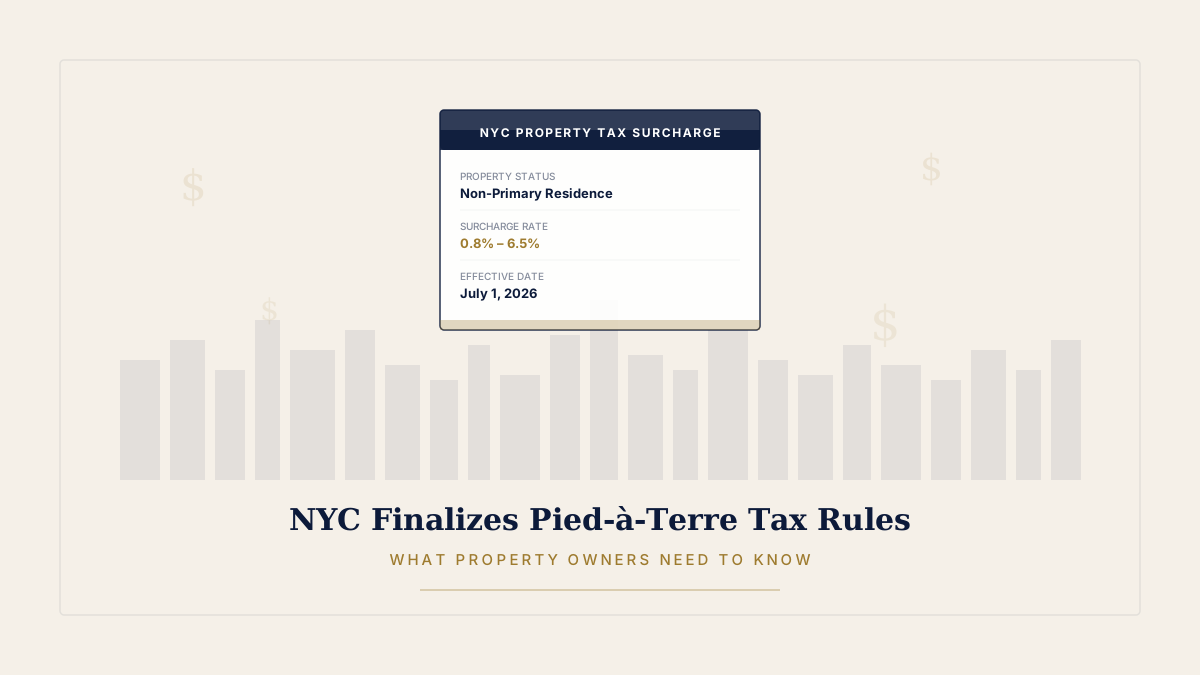
After years of proposals and political debate, New York City's pied-à-terre tax is now law. Governor Kathy Hochul signed the legislation on May 28, 2026, as part of the 2026–2027 state budget. On July 14, 2026, the NYC Department of Finance (DOF) adopted final administrative rules implementing the surcharge. The first property tax bills reflecting the new surcharge will be due January 1, 2027.
The tax is an annual surcharge on high-value residential properties in New York City that are not used as the owner's primary residence. It applies to one- to three-family homes with a DOF market value of $5 million or more and to condominiums and cooperative units with a DOF market value of $1 million or more. The DOF estimates that approximately 10,000 properties will be subject to the surcharge, generating an estimated $500 million in annual revenue.
The rollout has not been smooth. The DOF initially published a preliminary list capturing over 960,000 properties, causing widespread confusion before clarifying that only approximately 17,000 property owners received formal surcharge notices. A legal challenge filed on August 7, 2026, resulted in a temporary restraining order pausing certain aspects of the implementation, though the City has appealed.
This post covers what New York real estate owners and buyers need to know: which properties are affected, the graduated rate schedule, available exemptions, entity ownership issues, the current legal challenge, and what property owners should do now.
Background: From Proposal to Law
The concept of taxing high-value non-primary residences in New York City has been debated for over a decade. Former NYC Comptroller Scott Stringer proposed a version in 2014. State Senator Brad Hoylman-Sigal introduced legislation (S.44) in 2019 that would have imposed an annual tax on non-primary residences valued over $5 million. That proposal was shelved during the 2019 budget session in favor of one-time increases to the mansion tax and transfer tax.
The concept gained new momentum as the City faced budget pressures. On May 27, 2026, the New York State Legislature approved the pied-à-terre surcharge as part of the state budget bill (S. 9009C). Governor Hochul signed it the following day. The law took effect on July 1, 2026, and is currently scheduled to sunset on June 30, 2031, unless the Legislature renews it.
Which Properties Are Subject to the Surcharge?
The surcharge applies to New York City residential properties that meet two conditions: (1) the property's DOF market value exceeds certain thresholds, and (2) the property is not used as the primary residence of the owner or certain qualifying family members.
Class 1 Properties: One- to Three-Family Homes
Class 1 properties include detached, semi-detached, and attached one- to three-family homes. These properties are subject to the surcharge when their DOF market value is $5 million or more. In practice, this captures a relatively small number of properties — primarily high-end brownstones, townhouses, and single-family homes in Manhattan, brownstone Brooklyn, and certain neighborhoods in Queens and Staten Island.
Class 2 Properties: Condominiums and Co-ops
Class 2 properties include condominium units and cooperative apartments. These are subject to the surcharge when their DOF market value is $1 million or more. This threshold is significantly lower than the $5 million threshold for Class 1 properties, but the DOF notes that $1 million in DOF-assessed market value for a Class 2 property is generally comparable to $5 million in actual market value for a Class 1 property, due to differences in valuation methodology between the two property classes.
This distinction is important: the $1 million figure is not the unit's purchase price or current market price. It is the DOF's assessed market value, which uses income-based valuation methods for Class 2 properties and typically produces a figure substantially below actual market value. Property owners can check their DOF market value on the NYC Department of Finance's property tax portal or on the July 25 Assessment Roll Addendum.
Graduated Rate Schedule
The surcharge uses a graduated rate structure that varies by property class and value. During Phase 1 (July 1, 2026 through June 30, 2028), the rates are:
Class 1 Rates (One- to Three-Family Homes)
- $5 million to $15 million DOF market value: 0.8% of entire market value
- $15 million to $25 million: 1.05% of entire market value
- Over $25 million: 1.3% of entire market value
Class 2 Rates (Condominiums and Co-ops)
- $1 million to $3 million DOF market value: 4.0% of entire market value
- $3 million to $5 million: 5.25% of entire market value
- Over $5 million: 6.5% of entire market value
The rate applies to the property's entire DOF market value — not just the portion above the threshold. A Class 2 property with a DOF market value of $1.2 million pays 4.0% on the full $1.2 million, not just on the $200,000 above the $1 million threshold. This is a meaningful distinction that increases the effective surcharge substantially.
Phase 2: July 1, 2028 Onward
Beginning July 1, 2028, the surcharge structure will change. The threshold for all property types will become $5 million in market value under a new DOF assessment methodology that is expected to more closely align assessed values with actual market values for condos and co-ops. The Phase 2 rates have not yet been fully detailed, but the statute provides that the Class 1 rate schedule will apply uniformly to all non-exempt properties above the $5 million threshold.
What the Surcharge Costs in Practice
To illustrate the impact: a condominium with a DOF market value of $2 million that is not a primary residence would owe an annual surcharge of $80,000 (4.0% × $2 million) — on top of regular NYC property taxes. A townhouse with a DOF market value of $8 million would owe $64,000 (0.8% × $8 million). A luxury condo with a DOF market value of $6 million would owe $390,000 annually (6.5% × $6 million).
These figures are separate from and in addition to the property's existing NYC property tax bill, the NYC mansion tax paid at purchase, and any NYC transfer tax paid at purchase or sale. For foreign buyers who already face FIRPTA withholding on sale and potential U.S. estate tax exposure, the pied-à-terre surcharge adds another significant annual carrying cost.
Exemptions: Primary Residence and Qualifying Rental
The law provides exemptions for properties that serve as primary residences and for certain qualifying rental properties.
Primary Residence Exemption
A property is exempt if it is used as the primary residence of the owner — or the owner's spouse, child, sibling, parent, grandparent, or grandchild — for more than half of the tax year. "Primary residence" means the place where the individual maintains their principal home. The DOF considers factors including voter registration, driver's license address, income tax filings, and the amount of time spent at the property.
Owners who received a DOF notice indicating their property may be subject to the surcharge must affirmatively apply for the exemption by September 18, 2026. This deadline was extended from the original August dates after rollout confusion. If the DOF denies the exemption application, the owner may appeal to the NYC Tax Commission.
Qualifying Rental Exemption
Properties rented to qualifying tenants may also be exempt under certain conditions. The details of the qualifying rental exemption are addressed in the DOF's final rules adopted July 14, 2026. Generally, the property must be rented at fair market value to an unrelated tenant who uses it as their primary residence. Properties rented on a short-term or seasonal basis — including those listed on platforms like Airbnb — do not qualify.
What Does Not Qualify as an Exemption
The following do not create an exemption: using the property occasionally or seasonally, maintaining the property as a vacant secondary home, renting the property on short-term or vacation rental platforms, or claiming a property as a "home office" when the owner's primary residence is elsewhere. The surcharge is specifically designed to capture these use patterns.
Entity Ownership: LLCs, Trusts, and Look-Through Rules
One of the most complex aspects of the new law is how it treats properties held through legal entities. The statute includes look-through provisions that prevent owners from avoiding the surcharge by holding property through LLCs, trusts, partnerships, or corporations.
LLCs and Partnerships
The law looks through entity ownership to identify the beneficial owners. For LLCs, the primary-residence exemption may be available if the property is the primary residence of an individual who holds a majority ownership interest in the LLC. However, where no single individual holds a majority interest — common in family LLCs where ownership is split among siblings or other relatives — the property may be subject to the surcharge regardless of who actually lives there, unless it qualifies under the qualifying rental exemption.
This creates a practical problem for a common ownership structure: a family LLC in which parents transfer ownership interests to adult children over time for estate planning purposes. If no single child holds a majority interest after the transfers, the property may lose its exemption even if a family member continues to live there.
Trusts
For trust-owned properties, the primary-residence exemption may apply if the property is the primary residence of the trust's sole beneficiary. Trusts with multiple beneficiaries present more uncertainty — the statute suggests that the exemption may not be available if more than one beneficiary exists, even if one of them lives in the property as a primary residence. Irrevocable trusts, revocable living trusts, and qualified personal residence trusts (QPRTs) each raise distinct questions that the statute does not fully address.
Tiered Structures
The legislation does not expressly address tiered ownership arrangements — for example, a trust that owns an LLC that holds title to the property, or an LLC owned by another LLC. Until the DOF issues additional guidance, the application of the surcharge to these structures remains uncertain. Property owners with complex ownership structures should consult with a real estate attorney and tax advisor to evaluate their exposure.
The DOF Rollout: Assessment Roll and Notices
The DOF's implementation of the surcharge has been marked by confusion. In late July 2026, the DOF published a preliminary list that captured over 960,000 properties that could potentially be subject to the tax. This list caused widespread alarm among property owners and their advisors, as it appeared to include a vast number of primary residences.
The DOF subsequently clarified that only approximately 17,000 property owners received formal surcharge notices, mailed on July 22, 2026. The discrepancy arose because the preliminary list included all properties that met the value thresholds without filtering for primary-residence status. The formal notices were sent only to owners whose DOF records did not establish primary-residence status.
On July 25, 2026, the DOF published the Assessment Roll Addendum, which lists properties designated as potentially subject to the surcharge. Property owners should check the Addendum to confirm whether their property appears, even if they did not receive a notice in the mail. The Addendum is available on the DOF's website.
The Legal Challenge
On August 7, 2026, a group of NYC homeowners filed an Article 78 proceeding in New York Supreme Court, Richmond County (Staten Island), challenging the DOF's administration of the surcharge. The lawsuit does not challenge the constitutionality of the tax itself. Instead, it targets procedural aspects of how the DOF is implementing the law — specifically, the argument that the DOF is improperly shifting the burden to property owners to prove they qualify for the primary-residence exemption, rather than making an initial affirmative determination of non-primary-residence status.
On August 10, 2026, the court issued a temporary restraining order (TRO) pausing certain aspects of the rollout. The City filed a notice of appeal on August 11, 2026. The next hearing is scheduled for August 31, 2026.
The outcome of this litigation is uncertain. Even if the TRO remains in effect through the hearing, it may be limited in scope. Property owners should not rely on the litigation as a reason to miss deadlines. The exemption application deadline remains September 18, 2026, and property owners who fail to apply may lose the ability to claim an exemption for the 2026–2027 fiscal year regardless of how the litigation resolves.
Impact on Different Property Owner Groups
Second-Home Owners
New York residents who own a second home in the city — a pied-à-terre in Manhattan while maintaining a primary residence in Westchester, Long Island, Connecticut, or New Jersey — are the primary targets of the surcharge. For properties at the lower end of the value thresholds, the annual surcharge may be manageable. For high-value properties, particularly condos and co-ops in the 6.5% bracket, the surcharge may fundamentally change the economics of owning a secondary city residence.
Foreign and Out-of-State Investors
Foreign nationals and out-of-state investors who own high-value NYC residential property as investments or seasonal residences face the full impact of the surcharge with no exemption path (unless they can qualify under the rental exemption). For foreign buyers who structured their purchases through LLCs for estate tax planning, the look-through provisions mean that the LLC structure provides no protection from the surcharge. The tax adds to an already substantial cost stack that includes regular property taxes, potential FIRPTA withholding on eventual sale, and U.S. estate tax exposure on the $60,000 exemption threshold.
Buyers Entering the Market
Prospective buyers of high-value NYC residential property — whether as a primary residence or as a second home — should factor the potential surcharge into their purchase analysis. While primary-residence buyers are exempt, buyers who plan to use the property as a pied-à-terre or investment should model the annual surcharge as a carrying cost alongside property taxes, common charges, insurance, and maintenance. For a detailed overview of buying residential property in New York, see our 2026 resource guide.
Estate Planners and Trust Owners
The look-through provisions for trusts and multi-member LLCs create potential pitfalls for estate planning structures that were not designed with this surcharge in mind. Families who have already transferred property interests to trusts or family LLCs should review their ownership structures with counsel to determine whether the exemption is available or whether restructuring is advisable. Families considering future transfers should evaluate the surcharge implications before executing estate plans that would dilute individual ownership below majority thresholds.
What Property Owners Should Do Now
If you own residential property in New York City that may meet the value thresholds, take the following steps:
- Check the July 25 Assessment Roll Addendum on the DOF website to determine whether your property has been designated as potentially subject to the surcharge
- Review any DOF notice you received to confirm the surcharge amount and understand the exemption application process
- File an exemption application by September 18, 2026 if you believe your property qualifies for the primary-residence or qualifying-rental exemption — do not wait for the litigation to resolve
- Review your ownership structure if the property is held through an LLC, trust, or other entity — determine whether the look-through provisions affect your exemption eligibility
- Consult with a real estate attorney and tax advisor to evaluate the surcharge's impact on your carrying costs, investment return, and estate plan
- Preserve your appeal rights — if the DOF denies your exemption application, you may appeal to the NYC Tax Commission, but you must act within the applicable deadlines
How Yazdi Law Can Help
Yazdi Law represents residential and commercial real estate clients throughout New York City. If you own property that may be subject to the pied-à-terre surcharge, we can help you evaluate your exemption eligibility, review your ownership structure for look-through issues, prepare and file exemption applications, and advise on restructuring options if your current ownership arrangement creates surcharge exposure.
For prospective buyers, we incorporate the pied-à-terre surcharge analysis into our residential closing representation, ensuring that you understand the full carrying cost of the property before closing. Bilingual English and Farsi representation is available for clients who prefer it.
Contact us at (917) 565-7286 or through the form below to schedule a consultation.