For accomplished professionals, the O-1 visa is the most powerful work visa in U.S. immigration law — and the most misunderstood. There is no annual cap, no lottery, and no limit on extensions. It is available to scientists and startup founders, artists and athletes, physicians and fashion designers. And unlike the H-1B, where eligibility is largely a checklist, the O-1 is won or lost on how the evidence is built and argued.
New York is arguably the O-1 capital of the country: the researchers and physicians of its academic medical centers, the founders of its startup ecosystem, the artists, designers, musicians, and chefs for whom the city is the industry itself. This guide walks through the full O-1 process — who qualifies, the evidence criteria, the petition mechanics, costs, timelines, and the strategic decisions that determine outcomes. For the firm’s representation in these cases, see our O-1 visa practice page.
What the O-1 Is: Two Visas, One Standard of Excellence
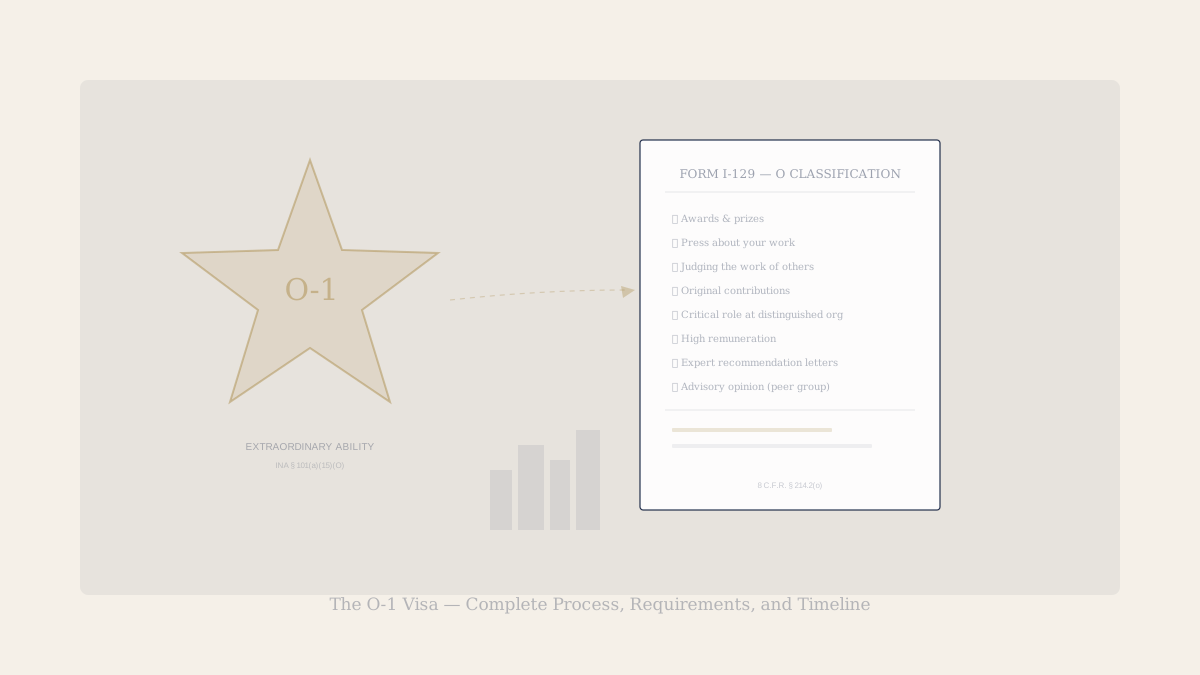
Created by INA § 101(a)(15)(O) and implemented at 8 C.F.R. § 214.2(o), the O-1 comes in two flavors:
- O-1A — extraordinary ability in the sciences, education, business, or athletics. The standard: you are among “the small percentage who have arisen to the very top of the field.” This is the visa of researchers, engineers, data scientists, founders, executives, physicians, and athletes
- O-1B — extraordinary ability in the arts, or extraordinary achievement in motion picture/television. The arts standard is distinction — a degree of skill and recognition substantially above that ordinarily encountered. “Arts” is read broadly: performers, visual artists, designers, chefs, choreographers, creative directors
Support personnel essential to an O-1 holder’s performance may qualify for O-2 status (athletics and arts), and spouses and children under 21 receive O-3 — they may study, but not work.
The Qualification Test: One Major Award or Three Criteria
There are two routes to eligibility. The first — a single major internationally recognized award (a Nobel Prize, an Olympic medal, a Grammy for O-1B) — is rare. Nearly every real-world petition travels the second route: satisfying at least three of the regulatory criteria.
The O-1A Criteria
- Nationally or internationally recognized prizes or awards for excellence in the field
- Membership in associations that require outstanding achievement, judged by recognized experts
- Published material about you and your work in professional or major media
- Judging the work of others — peer review, grant panels, competition judging, program committees
- Original contributions of major significance — the heart of most science and business cases
- Authorship of scholarly articles in professional journals or major media
- Critical or essential employment at organizations with distinguished reputations
- High salary or remuneration relative to others in the field
The O-1B criteria parallel these with arts-specific analogues: lead or starring roles, critical reviews, commercial or critically acclaimed success, recognition from organizations and experts, and high remuneration.
The strategic insight most applicants miss: meeting three criteria on paper is the floor, not the case. USCIS evaluates whether the totality of the evidence shows you are at the top of your field. A petition with three thin criteria invites a Request for Evidence; a petition with four or five well-documented criteria, tied together by a persuasive narrative, gets approved. The craft lies in choosing which criteria to claim — pressing strength, not padding weakness — and in defining the field itself: “machine learning for medical imaging” is a field in which a strong candidate can be extraordinary; “computer science” may not be.
The Evidence That Actually Wins
Four components separate strong O-1 petitions from weak ones:
1. The support letter. The petition’s brief — typically 15 to 30 pages — mapping every exhibit to its regulatory criterion and arguing, in plain terms, why this record shows extraordinary ability. Officers decide cases on this document; exhibits without argument are just paper.
2. Expert recommendation letters. Five to eight letters from recognized authorities — ideally a mix of people who know your work and independent experts who know of it. The letters that persuade explain what you did, why it mattered, and how it influenced the field, in concrete terms. Letters that merely praise (“brilliant, dedicated, among the best I have worked with”) are discounted.
3. Objective documentation. Citation records, press clippings with circulation data, award criteria showing selectivity, salary surveys proving high remuneration, download and usage metrics, box office or streaming numbers, organizational charts showing the critical role. Every claim in the letters should have a document behind it.
4. The advisory opinion. A written consultation from the appropriate peer group, union, or management organization is mandatory for nearly all petitions — unions and guilds for artists and entertainment workers (film/TV cases need both labor and management consultations), peer groups or expert statements for fields without them. Defective consultations are among the most common procedural causes of RFEs.
Who Files: Employers, Agents, and the Founder Question
The O-1 requires a U.S. petitioner — you cannot file purely in your own name. Three structures cover virtually every case:
- A U.S. employer — the straightforward case: a university, hospital, company, or team petitions for its hire
- A U.S. agent — for beneficiaries who work for multiple end clients: artists on tour, freelancers, consultants. The agent files with an itinerary of engagements and contracts or deal memos covering the visa period
- The beneficiary’s own company — the founder structure. A startup can petition for its founder where the petition demonstrates the company’s separate existence and authority over the founder’s work — commonly through a board of directors, investor oversight, or an agency arrangement. This is now a well-trodden path for New York founders, but the corporate structure must be designed before filing, not explained after an RFE
The Process, Step by Step
- Strategy and field definition (week 1). Identify the criteria to claim, define the field, and choose the petitioner structure
- Evidence building (weeks 2–10). Gather documentation, draft and collect expert letters, assemble the itinerary and contracts, request the advisory opinion
- Filing. The petitioner files Form I-129 with the O supplement — up to one year before the start date. 2026 government fees: $1,055 I-129 ($530 for small employers and nonprofits), plus the $600 Asylum Program Fee ($300 small employers; $0 nonprofits)
- Adjudication. Regular processing runs months; premium processing ($2,965) compels USCIS action within 15 business days and is used in most O-1 filings. “Action” can be approval — or an RFE, which pauses the clock
- Visa issuance or change of status. Beneficiaries abroad take the approval to a consular interview (DS-160); beneficiaries already in the U.S. in another status may change status on the same petition. Iranian nationals and others subject to enhanced vetting should plan for possible administrative processing delays under INA § 221(g) — a planning issue our Iranian clients know well
- Admission and extensions. Initial period up to three years; extensions in one-year increments, without limit
O-1 vs. H-1B vs. EB-1A: Choosing the Right Vehicle
The O-1’s advantages over the H-1B are structural: no lottery, no annual cap, no prevailing wage requirement, no six-year limit, and availability year-round. Its demands are correspondingly higher — an H-1B requires a specialty occupation and a degree; an O-1 requires a documented record of distinction. For professionals who lose the H-1B lottery, the O-1 is the most common Plan B worth building toward; for founders, it is usually Plan A.
The deeper strategy is the O-1 → EB-1A pipeline. The EB-1A extraordinary ability green card uses substantially overlapping criteria, requires no employer at all, and is current for most countries — making it one of the fastest routes to permanent residence. A well-planned O-1 petition is built with the EB-1A in mind: the same record, strengthened during the O-1 years with new publications, judging invitations, and press, matures into a self-petitioned green card. Because the O-1 is treated as dual-intent in practice, pursuing the green card does not jeopardize the visa. Our EB-1 guide covers the second stage in depth.
Common Pitfalls — and How to Avoid Them
- Defining the field too broadly — extraordinary “in business” is nearly unprovable; extraordinary in a precisely defined specialty is winnable
- Padding weak criteria instead of pressing strong ones — three solid criteria beat six thin ones
- Template recommendation letters — officers read thousands; letters must carry specific, verifiable substance
- Founder petitions without structure — the corporate governance showing the company’s authority over the founder must exist before filing
- Itinerary gaps in agent cases — the engagements must plausibly cover the visa period requested
- Ignoring the green card horizon — evidence decisions made for the O-1 either build toward EB-1A or squander the overlap
Work With a New York O-1 Visa Attorney
The O-1 is an argument, not an application — and arguments are won by preparation. Yazdi Law builds O-1 petitions for scientists, founders, artists, and professionals across New York’s industries from our office at 261 Madison Avenue in Midtown Manhattan: criteria strategy and field definition, evidence development and expert letters, agent and founder structures, premium-processed filings, RFE responses, and the long-game planning that turns an O-1 visa into an EB-1A green card. Consultations are available in English, Farsi, and Punjabi — the firm serves many O-1 candidates from the Iranian academic and professional community, for whom consular strategy and administrative processing planning are part of the case from day one.
Call (917) 565-7286 or use the form below for an honest assessment of your record — what qualifies now, what gaps exist, and what it would take to close them.