
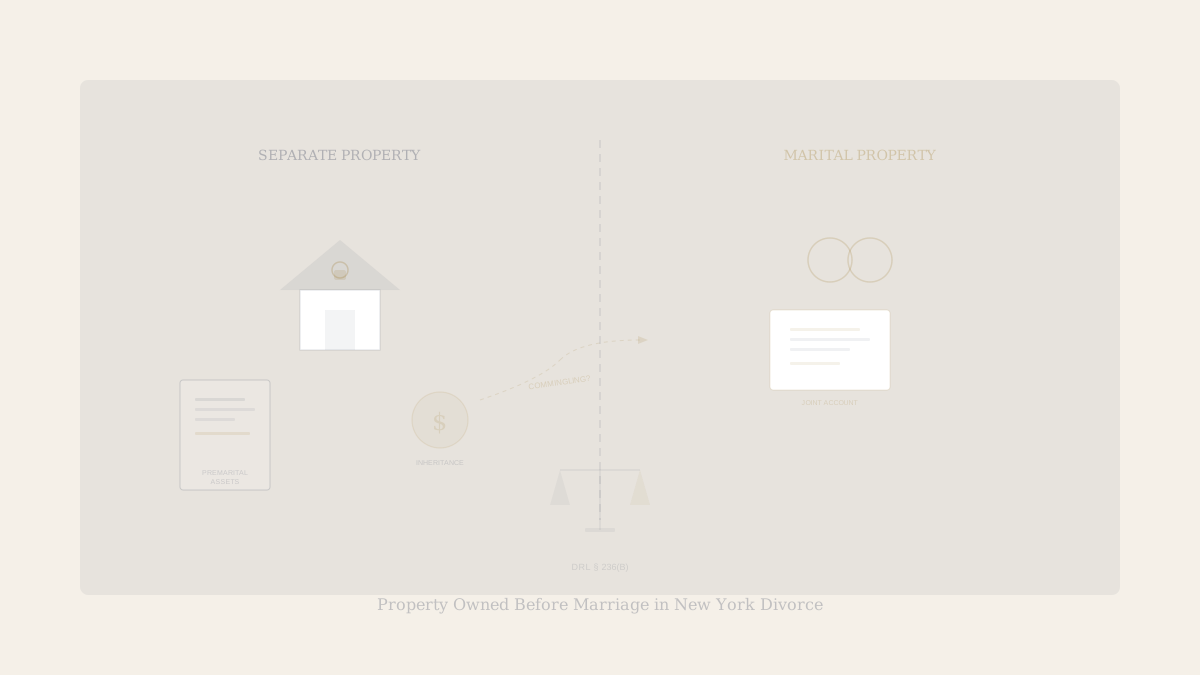
One of the most common questions in a New York divorce is whether property acquired before the marriage is protected from division. The short answer is that New York law classifies premarital property as separate property, which is not subject to equitable distribution. The longer answer — and the one that matters in actual divorce cases — is that this protection is not absolute. Premarital assets can lose their separate character during the marriage through commingling, retitling, and active appreciation, and the spouse claiming separate property bears the burden of proving it.
This post explains how New York courts classify and treat property owned before marriage in a divorce proceeding, when that property can become marital, and what steps you can take to protect premarital assets.
The Separate Property vs. Marital Property Distinction
New York is an equitable distribution state. When a couple divorces, the court divides marital property — but not separate property — between the spouses. The definitions of each are set by statute.
What Is Marital Property?
Under Domestic Relations Law § 236(B)(1)(c), marital property is all property acquired by either or both spouses during the marriage, regardless of the form in which title is held. It does not matter whose name is on the account or deed — if it was acquired during the marriage, it is presumptively marital. This includes real estate, bank accounts, investment and brokerage accounts, retirement contributions made during the marriage, vehicles, business interests acquired or grown during the marriage, and personal property.
What Is Separate Property?
Under DRL § 236(B)(1)(d), separate property includes:
- Property acquired before the marriage
- Property acquired by inheritance or bequest, whether before or during the marriage
- Property acquired by gift from a third party (not from the other spouse)
- Compensation for personal injuries (excluding lost earnings)
- Property designated as separate in a written agreement between the spouses, such as a prenuptial or postnuptial agreement
- Property acquired in exchange for or as the increase in value of separate property, except to the extent the increase is partly attributable to the contributions or efforts of the other spouse
That last category is where most disputes arise. It introduces the critical distinction between active and passive appreciation of separate property.
How Premarital Property Loses Its Separate Character
Premarital property starts as separate, but several common actions during a marriage can transform it — in whole or in part — into marital property.
1. Commingling
Commingling occurs when separate property is mixed with marital property to the point that the separate portion can no longer be traced. The most common scenario is depositing premarital savings into a joint bank account that also receives marital income (paychecks, joint business revenue, tax refunds). Once the funds are mixed and used interchangeably for joint expenses, the separate character of the original deposit may be lost.
Commingling does not automatically convert all funds to marital property. If the separate funds can be traced — if you can show through bank statements and transaction records exactly which dollars came from the premarital account and which came from marital income — the traceable separate portion retains its separate character. But tracing becomes exponentially harder over time as accounts are used, funds are transferred, and records are lost or incomplete.
2. Transmutation (Retitling)
Transmutation occurs when a premarital asset is retitled into joint names. The most common example is adding your spouse to the deed of a home you purchased before the marriage. New York courts generally treat this as converting the property — or at least a portion of it — into marital property. The reasoning is that retitling reflects an intent to make the property a gift to the marriage.
Transmutation can also occur with bank accounts (converting an individual account to a joint account), investment accounts (retitling brokerage accounts into joint names), and vehicles (adding a spouse to the title). The act of retitling does not have to be accompanied by an explicit statement of intent — the retitling itself is treated as evidence of the intent to share ownership.
3. Active Appreciation
Under the framework established by the Court of Appeals in Price v. Price (1986), the increase in value of separate property during the marriage is marital property to the extent that the increase is attributable to the contributions or efforts of the non-titled spouse or, in many cases, to the active efforts of either spouse using marital time and resources.
Active appreciation applies in several common contexts:
- Real estate: If you owned a rental property before the marriage and used marital funds and labor to renovate, manage, and improve it during the marriage, the appreciation attributable to those active efforts is marital property
- Businesses: If you owned a business before the marriage that grew in value during the marriage due to either spouse’s active management, the appreciation is partly or entirely marital
- Investment accounts: If you actively managed a premarital investment portfolio during the marriage — buying and selling securities, reinvesting dividends based on active decisions — the appreciation may be marital. Passive appreciation from market forces (e.g., holding index funds that rise with the market) is generally not marital
The distinction between active and passive appreciation is fact-intensive and frequently requires expert testimony from forensic accountants, business appraisers, or real estate experts.
4. Marital Funds Used to Maintain or Improve Separate Property
Even if a premarital asset is not retitled, using marital funds to maintain, improve, or pay down the debt on separate property can create a marital interest. If marital income (which belongs to both spouses) is used to pay the mortgage on a home you owned before the marriage, your spouse may have a claim to the portion of equity that marital contributions created. The same principle applies to renovations, capital improvements, property taxes, and insurance paid from marital funds.
This issue arises frequently when one spouse owned a home before the marriage and the couple moves into it as the marital residence. Over years of marriage, mortgage payments and improvements made with joint marital funds build equity that the non-titled spouse can claim.
Common Types of Premarital Property and How Courts Treat Them
The Premarital Home
A home purchased before the marriage is separate property — the original value at the time of marriage. Passive appreciation (the home’s value increases simply because the real estate market rises) is also separate. But if marital funds were used for mortgage payments, renovations, or significant improvements, the appreciation attributable to those contributions is marital. If the home was retitled into joint names, the entire property may be treated as marital.
When the premarital home served as the marital residence and the couple has minor children, the court also has the authority under DRL § 234 to award exclusive occupancy to the custodial parent, regardless of title. This does not transfer ownership but can delay a sale and affect both spouses’ housing situations post-divorce. Child custody arrangements often intersect with real property decisions in this way.
Retirement Accounts and Pensions
Retirement accounts (401(k), IRA, 403(b), pension plans) that existed before the marriage are partially separate and partially marital. The premarital balance — including any growth on that balance that is purely passive — is separate property. Contributions made during the marriage, plus employer matches and investment growth on those marital contributions, are marital property.
For pensions and defined benefit plans, the Majauskas formula (from Majauskas v. Majauskas, 1985) is the standard method for calculating the marital share: the total benefit is multiplied by a fraction equal to the years of marriage during which the employee participated in the plan, divided by the total years of plan participation. A Qualified Domestic Relations Order (QDRO) is typically required to effectuate the division without triggering tax penalties or early withdrawal penalties.
Investment and Brokerage Accounts
A brokerage account opened before the marriage is separate property as of the date of marriage. How it is treated going forward depends on management activity. An account that remains passively invested in the same holdings (an index fund, for example) and appreciates solely due to market performance retains its separate character. An account that is actively managed — trades are made, positions are changed, dividends are reinvested based on active decisions during the marriage — may see its appreciation classified as marital under the active appreciation doctrine.
If premarital and marital funds are deposited into the same brokerage account, tracing becomes essential. A forensic accountant may be needed to identify which gains are attributable to the premarital balance and which are attributable to marital contributions.
Business Interests
A business owned before the marriage presents one of the most contested separate property issues in contested divorces. The premarital value of the business is separate. But if the business grew during the marriage due to either spouse’s active efforts — whether as the owner-operator, through the other spouse’s support of the household enabling the owner to focus on the business, or through direct contributions to the business — the appreciation is marital.
Valuing a business for divorce purposes typically requires a forensic business appraiser who separates enterprise goodwill (marital) from personal goodwill (which may be separate), assesses pre- and post-marital values, and accounts for active versus passive appreciation. Business valuations can cost $10,000 to $50,000+ per expert, making this one of the most expensive components of a contested divorce.
Inheritance and Gifts
Inheritance and third-party gifts are separate property by statute, even when received during the marriage. However, the same commingling rules apply: an inheritance deposited into a joint account and used for joint purposes may lose its separate character. The key is documentation — keeping records of the inheritance’s source, maintaining it in a separate account, and not mixing it with marital funds.
Interspousal gifts — gifts between spouses during the marriage — are treated differently. New York courts generally classify interspousal gifts as marital property, not separate property. This means jewelry, cars, or other valuable items given by one spouse to the other during the marriage can be subject to equitable distribution.
Tracing: The Key to Protecting Separate Property Claims
In any dispute over separate property, the spouse claiming separate property bears the burden of proof. The primary method of proof is tracing — demonstrating through documentary evidence that the asset in question originated from a premarital or otherwise separate source and maintained its separate character throughout the marriage.
Effective tracing requires:
- Bank statements showing account balances on the date of marriage
- Purchase documents and deeds dated before the marriage
- Inheritance documentation — will, probate records, trust distribution records
- Gift letters from third parties documenting the source and intent of the gift
- Brokerage and investment statements showing premarital holdings and subsequent transactions
- Tax returns reflecting premarital income, assets, and capital gains
- Records showing that separate funds were kept in separate accounts throughout the marriage
When records are incomplete or assets were partially commingled, a forensic accountant may be necessary to reconstruct the financial history and isolate the separate and marital components. In high-asset divorces involving multiple accounts, real estate holdings, and business interests, forensic accounting is often the single most important piece of the case.
Strategies to Protect Premarital Property
The most effective time to protect premarital property is before the divorce — ideally before the marriage begins.
Prenuptial Agreements
A prenuptial agreement is the strongest tool for protecting premarital assets. Under DRL § 236(B)(3), a properly executed prenup can designate specific assets as separate property regardless of what happens during the marriage — even if they would otherwise lose their separate character through commingling, retitling, or active appreciation. A prenup can also establish valuation methods for businesses, define buyout terms for real estate, and waive equitable distribution claims on specific categories of property.
For the Iranian-American community, prenuptial agreements must be coordinated with the mahr (mehrieh) provision in the marriage contract to avoid conflicting obligations. Similarly, couples in the South Asian community should consider how cultural expectations around dowry and family contributions interact with New York’s equitable distribution framework.
Keep Separate Property Separate
If you do not have a prenup, the most important practical step is maintaining clear boundaries between separate and marital assets:
- Do not deposit premarital savings into a joint account. Maintain a separate individual account for premarital funds and do not add your spouse to it
- Do not add your spouse to the deed of premarital real estate. If you want your spouse to have occupancy rights, there are other legal mechanisms short of transferring title
- Do not use marital income to improve separate property without documentation. If marital funds are used for mortgage payments or renovations on a premarital property, document the source and amount of each contribution
- If you receive an inheritance during the marriage, keep it in a separate account titled only in your name. Do not commingle inherited funds with marital income
- Maintain records. Save account statements, deeds, titles, gift letters, and tax returns that document the premarital origin and separate maintenance of your assets
Postnuptial Agreements
If you are already married and did not sign a prenup, a postnuptial agreement can accomplish many of the same goals. A postnup must meet the same execution requirements as a prenup under DRL § 236(B)(3) — written, signed by both parties, and acknowledged before a notary. It can designate existing assets as separate property, establish terms for property division, and address spousal maintenance.
How Equitable Distribution Factors Affect Premarital Property
Even when premarital property is correctly classified as separate, it can indirectly affect the division of marital property. Under DRL § 236(B)(5)(d), the court considers 14 statutory factors when determining equitable distribution, including the income and property of each party at the time of the marriage and at the time of the commencement of the divorce action. A spouse with substantial separate property may receive a smaller share of marital assets because the court considers their overall financial position.
This means that having significant premarital wealth does not create a dollar-for-dollar offset against marital property, but it is one of many factors the court weighs. For a detailed analysis of how the 14 factors work, see our post on equitable distribution in New York.
The Marital Residence: A Special Case
The marital home receives special attention in New York divorces, regardless of when it was acquired. If a premarital home became the marital residence, the court considers both property-division principles and practical concerns about housing for children.
Under DRL § 234, the court can award exclusive occupancy of the marital residence to one spouse — typically the custodial parent — for a period of time, even if the other spouse owns the property. This does not transfer title but prevents the titled spouse from forcing a sale. Common outcomes include one spouse buying out the other’s interest (in the marital portion of the equity), selling the home and dividing the marital equity while the separate equity is returned to the original owner, or deferring the sale until the youngest child reaches a certain age.
New York City real estate valuations add complexity — the difference between a co-op (shares in a cooperative corporation), condo, and townhouse affects both valuation methodology and transfer logistics. Professional appraisals are virtually always required.
What to Do If You Are Facing a Divorce With Premarital Property at Stake
If you own property from before your marriage and are considering or facing a divorce, take these steps:
- Gather documentation. Collect all records that establish the premarital origin and value of your assets — bank statements, deeds, account statements, tax returns, and purchase records from before the marriage date
- Document how the assets were maintained. Show whether separate accounts stayed separate, whether marital funds were used on premarital property, and what improvements or changes were made during the marriage
- Do not make changes. Do not retitle, transfer, liquidate, or dissipate assets once a divorce is anticipated. Under CPLR Article 13-A, the court can issue an automatic restraining order preventing the disposal of marital assets once a divorce action is commenced
- Consult an attorney. The classification of premarital property is fact-intensive and the financial stakes are significant. An experienced matrimonial attorney can evaluate your specific assets, advise on tracing strategies, and, if necessary, engage forensic experts to support your claim
Contact Yazdi Law About Property Division in Your Divorce
Property division is often the most consequential financial issue in a divorce. Whether you are protecting premarital assets, disputing the classification of property, or navigating the equitable distribution of a complex marital estate, Yazdi Law provides experienced representation for clients throughout New York City.
We handle contested divorces involving significant asset classification disputes, uncontested divorces where the parties have agreed on property division, and prenuptial and postnuptial agreements designed to protect premarital wealth. Consultations are available in English and Farsi for members of the Iranian-American community.
Call (917) 565-7286 or use the form below to schedule a confidential consultation.