
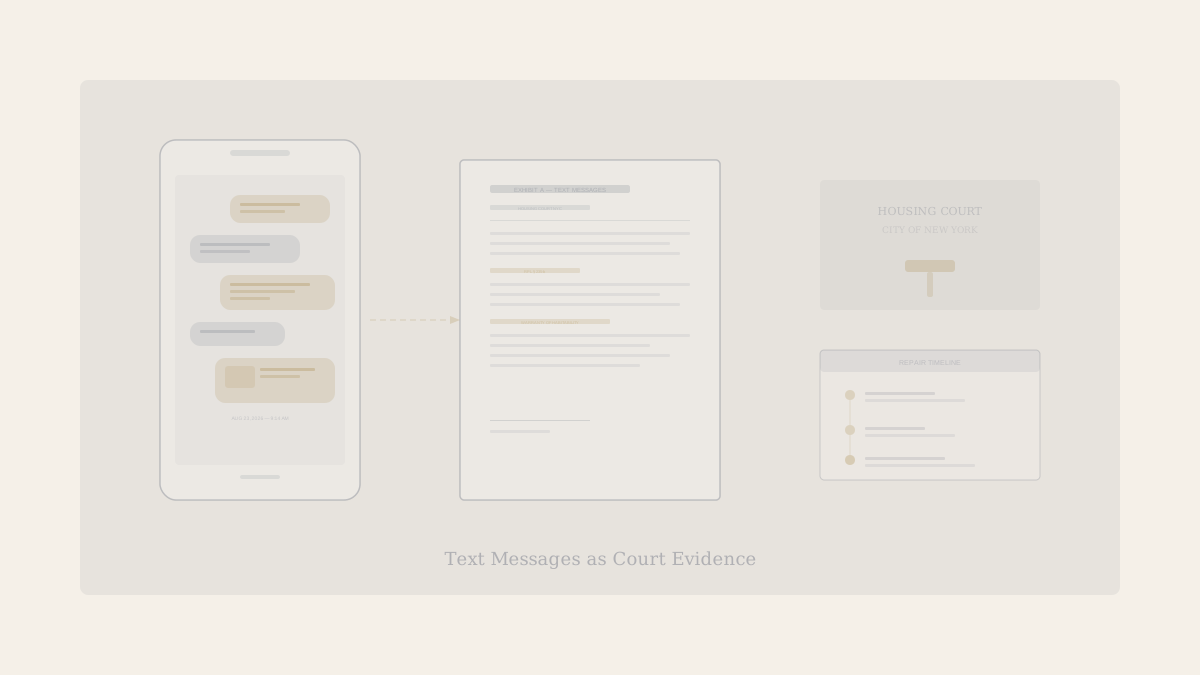
When a landlord ignores repair requests for weeks or months, the text messages sitting on your phone may be the strongest evidence you have. In New York Housing Court, judges routinely look at text message exchanges between tenants and landlords to determine how long a hazardous condition has existed — and whether the landlord had notice and failed to act.
If you are a tenant dealing with unaddressed repairs, saving those texts now could be the difference between winning and losing your case later. This guide explains why text messages matter in apartment repair disputes, how to preserve them properly, and how courts use them as evidence. It is written by a New York landlord-tenant attorney and is intended as a general overview, not legal advice for any specific situation.
Why Text Messages Matter in Apartment Repair Disputes
New York law imposes a warranty of habitability on every residential lease. Under Real Property Law (RPL) § 235-b, landlords must maintain rental units in a condition fit for human habitation. When a landlord breaches this warranty — by leaving a broken heater, persistent mold, a roach infestation, or a leaking ceiling unrepaired — tenants have the right to bring an HP (housing part) proceeding in Housing Court to compel repairs and seek a rent abatement.
To succeed, a tenant must prove two things:
- The condition existed and was serious enough to affect habitability.
- The landlord had notice of the condition and a reasonable opportunity to repair it.
Text messages are powerful evidence on both counts. They establish when you first notified the landlord, what you described, and how long the problem went unresolved. A string of unreturned texts over several months paints a clear picture for a judge.
What Makes Text Messages Admissible in New York Courts
Text messages are generally admissible as electronically stored information (ESI) under CPLR § 4518 and the rules governing ESI. To get them admitted, you typically need to establish:
- Authentication — Show that the messages are what you claim they are. Under CPLR § 4539(b), a printout or screenshot of electronic records is admissible if you can demonstrate it accurately reflects the original. Screenshots with visible phone numbers, contact names, and timestamps usually satisfy this requirement.
- Relevance — The messages must relate to the condition at issue and the landlord’s notice. Texts saying “the ceiling is leaking again” or “when are you sending the plumber” are directly relevant.
- Hearsay considerations — A tenant’s own texts to the landlord are generally not hearsay because they are offered to show notice was given, not for the truth of the matter asserted. The landlord’s replies (or silence) may also come in as party admissions or as evidence of notice.
In practice, Housing Court judges in New York City handle text message evidence routinely. The key is presenting it clearly.
How to Preserve Text Messages as Evidence
Text messages can be lost if your phone breaks, if you switch carriers, or if messages are accidentally deleted. Follow these steps to protect your evidence:
Screenshot Everything
Take screenshots of the full conversation thread, making sure each screenshot shows:
- The contact name or phone number of your landlord, superintendent, or property manager
- Timestamps (date and time) on each message
- The complete text of each message — do not crop out parts of the conversation
Scroll through the entire conversation and capture it from beginning to end, not just isolated messages. Judges are more likely to find screenshots persuasive when they reflect the full exchange, including any responses from the landlord.
Back Up Your Screenshots
Do not rely on your phone alone. Save copies to:
- A cloud storage service (Google Drive, iCloud, Dropbox)
- Your email — send the screenshots to yourself so they have an independent timestamp
- A USB drive or computer
If you need to show the messages in court, you want at least two separate copies in case one is lost or corrupted.
Use Your Phone’s Built-In Export Feature
Both iPhone and Android offer ways to export text conversations. iPhone users can take scrolling screenshots (long screenshots) or use third-party apps to export iMessage conversations as PDFs. Android users can select and copy text in Google Messages or use apps like SMS Backup & Restore to export entire threads.
A PDF export of the full conversation, with timestamps and phone numbers intact, is often the cleanest format to present in court.
Follow Up Phone Calls With a Text
If you have been calling your landlord to complain about repairs, follow up every phone call with a text message summarizing what you discussed:
“Following up on our call — you said the plumber would come this week to fix the kitchen leak. Please confirm.”
This creates a written record that supplements your verbal complaints and is much easier to prove in court than testimony about a phone call.
What to Include in Your Text Messages to the Landlord
When you text your landlord about a repair issue, include specific, factual details:
- Describe the condition clearly — “There is a water leak coming from the ceiling in the bedroom” is stronger than “there’s a problem.”
- Note how long it has been going on — “This leak started two weeks ago and is getting worse.”
- Mention any health or safety risks — “There is mold growing around the leak” or “we have no heat and it is below freezing.”
- Request a specific repair and a timeline — “Please send someone to fix this by the end of the week.”
- Attach photos or videos — Pictures of the damage, mold, leaks, or broken fixtures strengthen your case significantly. A photo with a visible date stamp next to a text message describing the same condition is compelling evidence.
How Judges Use Text Message Evidence in Housing Court
In an HP proceeding or a tenant’s defense against a nonpayment case, Housing Court judges look at text messages to evaluate:
- Landlord notice — Did the landlord know about the condition? An unanswered text from three months ago proves the landlord had actual notice long before the case was filed.
- Duration of the condition — A series of texts spanning several months shows the condition was ongoing and not a one-time issue. This directly affects the rent abatement a judge may award. Under RPL § 235-b, tenants are entitled to a reduction in rent for the period during which conditions rendered the apartment less habitable. The longer the landlord ignored the problem, the larger the potential abatement.
- Landlord response or lack thereof — If the landlord replied “I’ll send someone next week” and then did nothing for two months, the text trail exposes that pattern. Judges view repeated empty promises unfavorably.
- Tenant credibility — Consistent, dated texts that match the tenant’s testimony strengthen the tenant’s overall credibility.
Beyond Text Messages: Building a Complete Record
Text messages are most effective when combined with other evidence:
- 311 complaints — Filing a complaint with NYC 311 about a housing condition creates an official record. HPD (the Department of Housing Preservation and Development) may inspect the apartment and issue violations against the landlord. HPD violations are strong evidence in Housing Court.
- Photographs and video — Take photos of the condition at regular intervals, especially if it worsens over time. Your phone automatically timestamps photos in the metadata.
- Emails and letters — Sending a formal written complaint (especially by certified mail) supplements your text messages and shows the landlord was notified through multiple channels.
- Repair receipts — If you had to pay for emergency repairs yourself, keep receipts. Under certain circumstances, tenants can recover the cost of repairs they made when the landlord refused to act.
Common Mistakes That Weaken Your Case
- Deleting old messages — Even if you are frustrated, do not delete the conversation thread. Once litigation is reasonably anticipated, you may have a duty to preserve relevant evidence under New York’s spoliation rules.
- Editing or selectively screenshotting — Presenting only favorable texts and omitting unfavorable ones can damage your credibility. Produce the full conversation.
- Texting threats or profanity — Keep your messages professional and factual. Hostile or threatening language can undermine your position, even if your underlying complaint is legitimate.
- Not identifying the recipient — If you are texting a superintendent or property manager rather than the landlord directly, make sure the record shows who you were communicating with and their role. Courts need to determine whether the person receiving the text had authority to act on behalf of the landlord.
When Text Messages Alone Are Not Enough
While text messages are valuable evidence, they may not be sufficient on their own in every case. If the landlord disputes the severity of the condition, you may need:
- An HPD inspection — An HPD inspector’s report documenting violations carries significant weight. You can request an inspection by calling 311 or filing online.
- Expert testimony — In cases involving mold, lead paint, or structural issues, a professional inspection report or expert testimony may be necessary.
- Testimony from other tenants — If the problem affects multiple units, testimony or written statements from neighbors can corroborate your claims.