
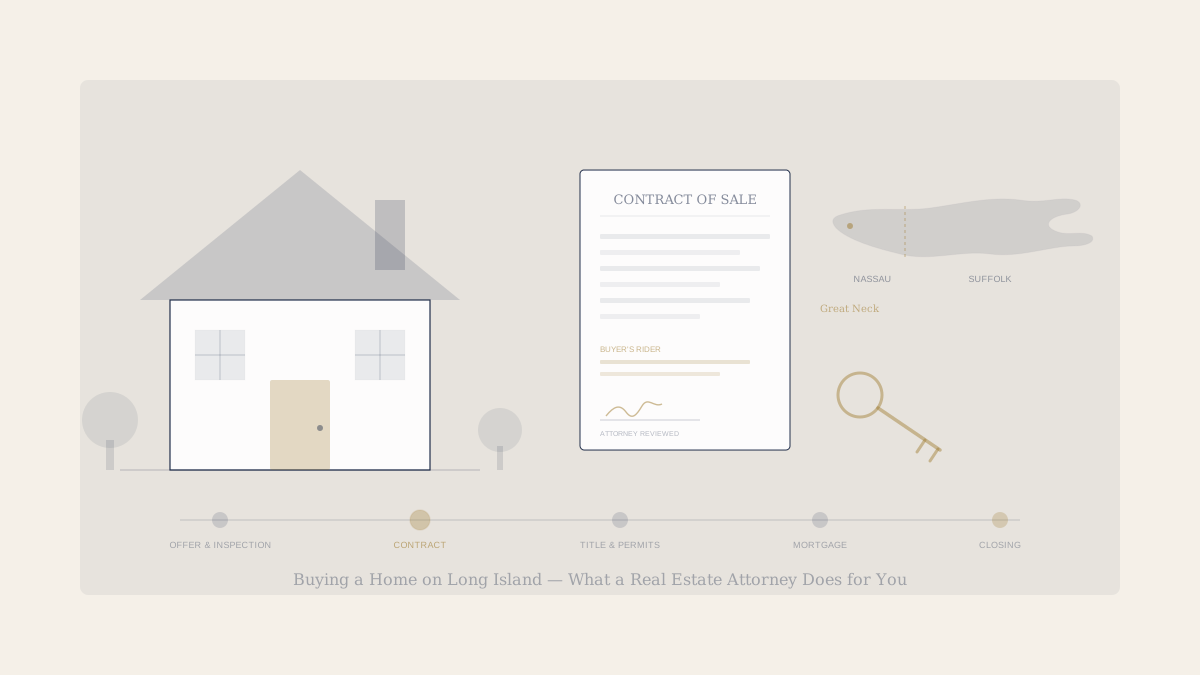
Buying a home on Long Island is a different transaction from buying an apartment in the city, and a different transaction from buying a house almost anywhere else in the country. New York is an attorney-driven state, so there is no escrow company guiding you from offer to keys; your real estate attorney is the person who negotiates the contract, clears the title, handles the permit and certificate of occupancy problems that Long Island houses are famous for, and sits beside you at closing. Nassau and Suffolk Counties then add their own layer: a different mortgage recording tax than the city, a flat mansion tax, county-specific recording fees, a property tax system built from overlapping town, school, and village levies, and, on the East End, the Peconic Bay transfer tax.
This guide walks through a Long Island home purchase in 2026 from accepted offer to recorded deed, with a focus on what a Nassau County or Suffolk County real estate attorney actually does at each stage and why it matters to your money. It is written for first-time buyers, families moving out from Queens and Brooklyn, buyers relocating to communities such as Great Neck, Manhasset, Roslyn, Garden City, Huntington, and the Hamptons, and anyone who has been told “just sign the contract and send the deposit” and wants to know what they are signing.
Why New York Puts an Attorney at the Center of Every Home Purchase
In most states, a buyer signs a standardized purchase agreement with the broker, and a title or escrow company shepherds the deal to closing. New York does not work that way. Here, the seller’s attorney drafts the contract of sale, usually starting from a standard form and adding a rider that favors the seller. The buyer’s attorney reviews that contract, negotiates a buyer’s rider, and only then does the buyer sign and deliver the deposit. From that point until closing, the buyer’s attorney orders and reviews title, coordinates with the lender’s counsel, resolves problems, and prepares the buyer for closing day.
Two consequences follow. First, an accepted offer on Long Island is not binding; either side can walk away until the contract is fully signed, which is why the contract phase moves quickly. Second, there is no formal attorney review period as in New Jersey: once you sign, the terms are the terms. The time to protect yourself is before signature, which is why the attorney should be retained the day the offer is accepted, not after the seller’s attorney sends the contract.
Nassau and Suffolk Are Not the Five Boroughs: What Changes When You Cross the City Line
Long Island buyers coming from Queens or Brooklyn often assume the costs and procedures are the same. Several are not:
- No city transfer tax. The NYC Real Property Transfer Tax of 1% to 1.425% does not exist in Nassau or Suffolk. Only the New York State transfer tax of 0.4% applies, and it is paid by the seller.
- A flat 1% mansion tax. On purchases of $1 million or more, the buyer pays a mansion tax of 1% of the full price. The graduated rates up to 3.9% apply only in New York City.
- A lower mortgage recording tax. Nassau and Suffolk charge 1.05% of the loan amount, compared with 1.8% to 1.925% in the city, and the lender pays 0.25% of it on one-to-six-family homes.
- County recording, not ACRIS. Deeds and mortgages are recorded with the Nassau County Clerk in Mineola or the Suffolk County Clerk in Riverhead, each with its own fee schedule and a tax map verification requirement.
- Houses, not co-ops. The inventory is overwhelmingly single-family, so surveys, certificates of occupancy, oil tanks, cesspools, and flood zones replace board packages and proprietary leases as the center of due diligence.
- Layered property taxes. A Long Island tax bill combines county, town, school district, and often village and special district taxes, with the school portion usually the largest.
For a side-by-side look at the city and Nassau County, including Great Neck specifically, see our guide to buying and selling property in NYC and Great Neck.
The Long Island Home Buying Process, Step by Step
Step 1: Pre-Approval and the Offer
Sellers’ agents on Long Island expect a mortgage pre-approval letter with the offer, and in competitive North Shore and Nassau markets a buyer without one is at a disadvantage. The offer itself is made through the brokers and is non-binding. When it is accepted, the listing agent circulates a deal sheet with the price, the parties, and the attorneys’ names, and the clock starts. This is the point to retain your attorney if you have not already.
Step 2: Inspections Before Contract
New York buyers inspect before they sign, not after. In the week or so between accepted offer and contract, you should complete a general home inspection and, depending on the property, a termite inspection, a radon test, an oil tank sweep for buried heating oil tanks, and a cesspool or septic inspection in the many parts of Suffolk County without public sewers. Because the contract will provide that you are taking the house essentially as-is, every negotiating point the inspection raises, from a failing roof to a leaking tank, has to be resolved by your attorney in the contract as a repair, a credit, or a price change. After signing, your leverage is gone.
Step 3: Contract Review and Negotiation
The seller’s attorney sends the contract of sale with a seller’s rider. Your attorney reviews and negotiates:
- The deposit: customarily 10% of the price, held in the seller’s attorney’s escrow account until closing
- The mortgage contingency: the amount, rate ceiling, and the number of days you have to obtain a commitment; what happens if the commitment is conditional or the appraisal comes in low; and your right to cancel and recover the deposit if financing is denied
- Certificates of occupancy and open permits: which party is responsible for legalizing unpermitted work before closing, discussed in detail below
- Condition at closing: representations that heating, plumbing, electrical, and appliances will be in working order, and that the roof will be free of leaks
- Personal property: which fixtures and appliances stay
- Closing date and possession: the target date, whether time is of the essence, and any post-closing possession arrangement if the seller needs extra time
- Estate, divorce, and sponsor sellers: the additional documents and protections required when the seller is an estate, a divorcing couple, a trust, or a builder
The seller must also deliver the Property Condition Disclosure Statement before you sign. Since the March 20, 2024 amendments to Real Property Law Article 14, sellers can no longer substitute a $500 credit for the form, and the form now includes flood risk, flood history, and flood insurance questions. Your attorney reads it against the inspection report and asks the questions it raises.
Step 4: Title Search, Survey, and Municipal Searches
Once the contract is signed, your attorney orders a title report from a title insurance company. The title report searches the public record for the chain of ownership, open mortgages, judgments, liens, easements, and restrictive covenants, and it includes municipal searches for certificates of occupancy, building permits, violations, and open street and sewer matters. A survey, either new or a certified update of the seller’s, confirms the boundaries, the location of the house, fences, driveways, and any encroachments, and it determines whether the title company will insure without survey exceptions.
Your attorney reviews every exception on the title report and decides which the seller must clear before closing (an unreleased mortgage from a prior refinance, a judgment against the seller, an open estate), which can be insured over, and which you simply need to understand (a utility easement along the rear lot line, a village covenant limiting fence heights). On Long Island, the municipal search is where most of the work happens.
Step 5: Mortgage Commitment and Lender Coordination
Your lender orders the appraisal and issues a commitment letter, and your attorney tracks the contingency deadline, requests an extension if underwriting is slow, and reviews the commitment conditions. On Long Island, lenders also scrutinize flood insurance requirements for homes in FEMA special flood hazard areas, which include much of the South Shore and parts of the North Shore waterfront, and they may require open permits to be resolved before closing. Our guide to what “clear to close” means covers the final underwriting stage.
Step 6: Closing
Long Island closings typically take place at the office of the lender’s attorney or the title company, often in Nassau or Suffolk County. Before closing, your attorney reviews the Closing Disclosure and the title company’s closing statement, confirms the adjustments for property taxes, fuel oil, and any village or water charges, arranges your wire for the balance, and reviews the deed, the transfer tax returns, and the lender’s documents. At closing you sign the mortgage documents and receive the deed and keys; the title company records the deed and mortgage with the county clerk afterward. Then your attorney follows up on recording and the issuance of your owner’s title policy, and you register for the STAR credit and update your insurance and utilities.
Long Island Closing Costs for Buyers in 2026
The table below lists the main buyer-side closing costs on a Long Island purchase. Every figure should be confirmed for your transaction; rates and fees change, and this table reflects published figures as of November 2026.
| Cost | Amount | Notes |
|---|---|---|
| NY State mansion tax (purchases of $1,000,000 or more) | 1% of the full purchase price | Flat 1% outside NYC; the higher graduated rates apply only in the five boroughs |
| Mortgage recording tax (Nassau and Suffolk) | 1.05% of the loan amount | Lender pays 0.25% on 1–6 family homes; $30 reduction on 1–2 family homes |
| Title insurance (owner’s and lender’s policies) | Rate set by TIRSA, based on price and loan | Plus title search, municipal searches, and endorsements |
| Survey or survey update | Varies by property | Required by most lenders and title companies for houses |
| Recording fees and tax map verification | Varies by county | Nassau charges a tax map verification fee per deed and mortgage; Suffolk has its own |
| Peconic Bay transfer tax (East End towns only) | 2% (2.5% in four towns) | Paid by the buyer above an exemption amount; see below |
| Attorney fee | Flat fee, quoted at consultation | Covers contract through closing |
| Lender fees, appraisal, prepaid taxes and insurance | Varies by lender | Itemized on the Loan Estimate and Closing Disclosure |
The Mansion Tax on Long Island
Under Tax Law § 1402-a, the buyer pays a 1% tax on residential purchases of $1 million or more. Outside New York City the rate is a flat 1% of the entire price, not just the amount over $1 million, so a $1.2 million purchase in Manhasset carries $12,000 in mansion tax. The threshold creates a cliff: $999,999 carries nothing, $1,000,000 carries $10,000. Buyers near the line sometimes negotiate the price under the threshold, which is legitimate; routing part of the price through a side payment to avoid the tax is not.
The Mortgage Recording Tax in Nassau and Suffolk
Under Tax Law § 253 and the Metropolitan Commuter Transportation District surcharge, the mortgage recording tax in Nassau and Suffolk Counties is 1.05% of the mortgage amount. On one-to-six-family homes the lender is required to pay 0.25% of that, so the borrower’s share is effectively 0.80%, and one- and two-family homes receive a $30 reduction. On a $600,000 mortgage, the buyer’s share is about $4,770. The tax does not apply to co-op share loans.
The Peconic Bay Tax on the East End
Buyers in the five East End towns of Suffolk County, East Hampton, Southampton, Shelter Island, Southold, and Riverhead, pay the Peconic Bay Region Community Preservation Fund transfer tax of 2%. East Hampton, Southampton, Shelter Island, and Southold added a 0.5% community housing fund tax beginning in 2023, bringing their total to 2.5%. The tax applies to the price above an exemption amount, with a higher exemption on the South Fork than on the North Fork, and several towns offer a first-time homebuyer exemption. On a Hamptons purchase this is often the largest line on the buyer’s closing statement, and the exact exemption and eligibility should be confirmed for the town before you make an offer.
The Long Island Problems a Real Estate Attorney Solves
Certificates of Occupancy and Open Permits
Nothing derails more Long Island closings. Towns such as Hempstead, North Hempstead, Oyster Bay, Huntington, Islip, Babylon, Smithtown, and Brookhaven, and the dozens of incorporated villages within them, require building permits and a certificate of occupancy or certificate of completion for additions, dormers, finished basements, decks, pools, converted garages, and added bathrooms. A large share of Long Island houses have work that was never permitted, or permitted but never closed out with a final inspection.
The municipal search reveals the gap between what the town has on file and what is standing on the lot. Your attorney then negotiates the fix in the contract: the seller legalizes the work and obtains the certificates before closing; the seller gives a credit or an escrow holdback so you can do it after closing; or you accept the condition with full knowledge and a price that reflects it. Lenders and title companies may refuse to close with significant open items, and a buyer who inherits unpermitted work will have to deal with it when selling, refinancing, or facing a village inspector. Handling this correctly, before signature, is one of the most valuable things a Long Island real estate attorney does.
Underground Oil Tanks
Oil heat is common on Long Island, and many pre-1990 homes had buried tanks. A leaking underground tank can mean a cleanup running into six figures, and homeowner’s insurers increasingly refuse coverage for properties with active buried tanks. Your attorney will insist on a tank sweep before contract and, if a tank is found, negotiate removal or proper abandonment with a certificate from the town or county, and a contractual allocation of responsibility if contamination is discovered.
Cesspools, Septic Systems, and Wells
Much of Suffolk County, and pockets of Nassau, rely on private cesspools or septic systems rather than sewers, and parts of the East End use private wells. The Suffolk County Department of Health Services regulates these systems, and failing or outdated cesspools can require replacement with an advanced nitrogen-reducing system at substantial cost. A septic inspection before contract, and contract language addressing what happens if the system fails, belong in every Suffolk purchase without sewer service.
Flood Zones and Flood Insurance
Communities along the South Shore, including Long Beach, Freeport, Massapequa, Lindenhurst, and Babylon, and waterfront areas across the North Shore and East End sit partly within FEMA special flood hazard areas. Lenders require flood insurance in those zones, premiums can be substantial, and elevation certificates matter. The amended Property Condition Disclosure Statement now requires sellers to answer flood questions, and your attorney will reconcile those answers with the flood map and your lender’s requirements before you are committed.
Property Taxes, Exemptions, and Grievances
Long Island property taxes are among the highest in the country, and the seller’s bill may not be your bill. Senior, veterans, and enhanced STAR exemptions drop off at transfer, and new owners must register for the STAR credit with the State Department of Taxation and Finance. Your attorney reviews the school, general, and village tax bills so that the lender’s escrow and your budget reflect what you will actually owe. In Nassau County, assessments are set by the County Department of Assessment and can be challenged through the Assessment Review Commission during a filing window that opens each January; in Suffolk County, grievances go to the town assessor beginning May 1 for the May grievance day. A purchase price well below the assessed market value is itself evidence for a grievance.
Title Defects, Estates, and Family Sellers
Older Long Island housing stock means older chains of title: homes passing through estates without a formal probate, unreleased mortgages from refinances decades ago, deeds between family members with defective acknowledgments, and village restrictive covenants from the 1920s. Each is solvable, but each takes time, and your attorney’s job is to identify them from the title report early and hold the seller to clearing them before you wire the balance. If you are buying with a spouse, partner, or family member, this is also the moment to decide how to hold title; our guide to joint tenancy versus tenancy in common explains the options.
Condos, Co-ops, HOAs, and New Construction on Long Island
Although houses dominate, Long Island has condominiums and homeowners’ associations in developments from Great Neck to Riverhead, co-op buildings in communities such as Great Neck, Long Beach, Rockville Centre, and Garden City, and a steady supply of new construction. Each changes the attorney’s work: for a condo or HOA, review of the offering plan, bylaws, budget, reserve fund, and any pending assessments or litigation; for a co-op, the board application, financial review, and recognition agreement with the lender; for new construction, a sponsor contract that is heavily weighted toward the builder and must be negotiated on deposit protection, completion dates, punch lists, and the certificate of occupancy. Our residential closings page describes how we handle each type.
Buying on Long Island From Abroad or Through an LLC or Trust
Non-U.S. citizens may buy Long Island property freely, but financing, tax identification, and the FIRPTA withholding rules that apply when a foreign owner later sells all require planning; see our foreign buyer guide. Buyers purchasing through an LLC or trust without financing should also be aware that federal anti-money-laundering reporting for non-financed residential purchases by entities and trusts took effect in 2026, and the closing attorney or title company will collect beneficial ownership information to comply.
For Iranian and Persian Buyers on Long Island
Great Neck, Kings Point, Roslyn, Manhasset, and the surrounding North Shore communities are home to one of the largest Iranian-American communities in the United States, and Yazdi Law represents many Iranian clients in Nassau County. Several patterns recur in these purchases: down payments gifted by parents or relatives, which lenders require to be documented with gift letters and source-of-funds records; multi-generational purchases in which parents and adult children co-own and co-borrow; funds arriving from abroad that must be traced to satisfy both the lender and federal sanctions compliance; and buyers who are more comfortable reviewing a contract, a commitment letter, and a closing statement in Farsi. Amirali Oloomiyazdi conducts consultations and reviews documents directly in Farsi, not through a translator, which in a transaction with a six-figure deposit is a practical safeguard rather than a convenience.
When to Call a Long Island Real Estate Attorney
The short answer is the day your offer is accepted, and ideally before you make one if the property has any of the complications above. An early conversation lets your attorney tell you what to inspect, what to ask the seller’s side for, and what the true closing costs will be before you are emotionally and financially committed. Buyers who engage counsel only after the contract arrives can still be protected, but the window is short and the seller’s attorney has already set the terms of the conversation.
Talk to a New York Real Estate Attorney About Your Long Island Purchase
Yazdi Law, PLLC represents home buyers throughout Nassau and Suffolk Counties, from Great Neck, Manhasset, Roslyn, and Port Washington to Garden City, Jericho, Syosset, Huntington, Smithtown, and the East End, as well as in all five boroughs. Residential purchase representation is handled on a flat fee quoted at the first consultation, and it covers everything from contract review and negotiation through title clearance, lender coordination, and closing. Our office is at 261 Madison Avenue in Midtown Manhattan; consultations are by phone or video, and the transaction itself is handled electronically with in-person attendance at closing. Consultations are available in English, Farsi, and Punjabi.
Call (917) 565-7286 or use the form below to discuss your purchase with a real estate attorney before you sign.