
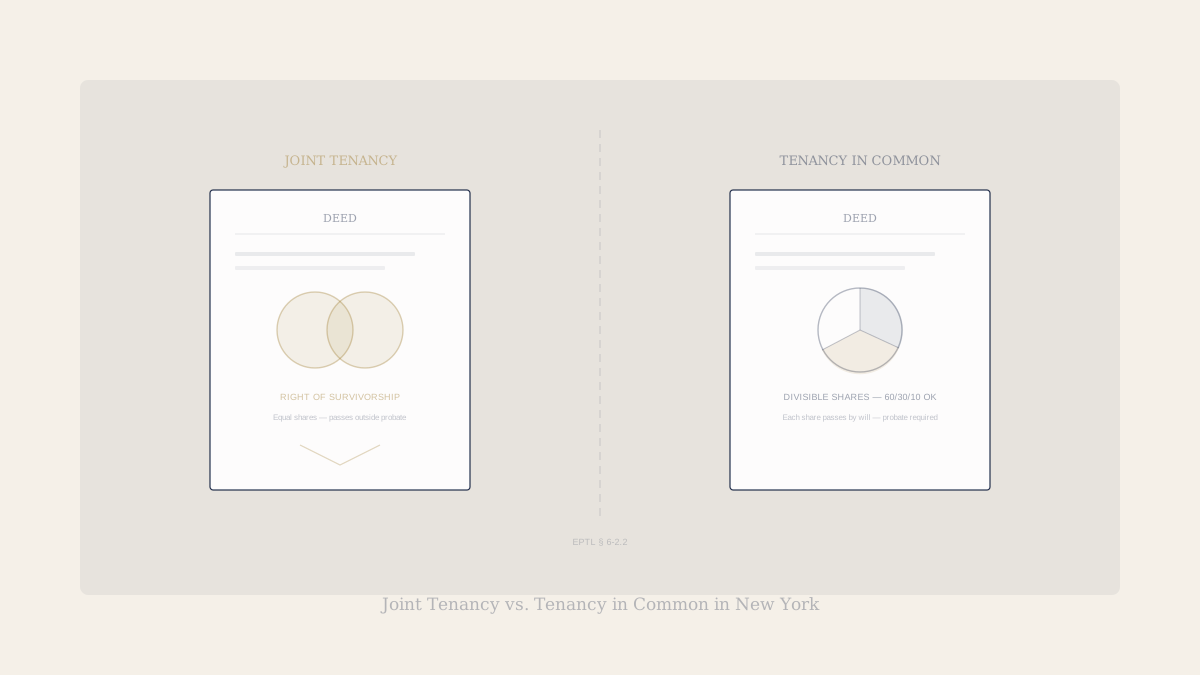
When two or more people buy property together in New York — spouses, siblings, unmarried partners, friends pooling resources to afford a first home, parents helping a child onto the property ladder — the deed must answer a question most buyers never think to ask: how will you hold title? The answer, chosen in a single line of the deed at closing, determines who inherits the property, whether it goes through probate, what a creditor can reach, and whether one owner can force a sale.
New York recognizes three principal forms of co-ownership: tenancy in common, joint tenancy with right of survivorship, and — for married couples only — tenancy by the entirety. Buyers who never make a deliberate choice get the statutory default, and the default is frequently not what they would have wanted. This guide explains how each form works, what each protects against (and doesn’t), and how to choose correctly for your situation.
The Default Rules: What New York Presumes
Start with the statute, because it decides every case where the deed is silent. Under EPTL § 6-2.2:
- A conveyance to two or more persons creates a tenancy in common, unless the deed expressly declares a joint tenancy
- A conveyance to a married couple creates a tenancy by the entirety, unless the deed expressly provides otherwise
The practical consequence: siblings who inherit a family house together, friends who split a condo purchase, and unmarried partners who close without discussing title are all tenants in common by default — meaning no survivorship. When one dies, their share goes to their estate, not to the co-owner standing next to them at the closing. Families discover this at the worst possible moment.
Tenancy in Common: Divisible Shares, Maximum Flexibility
A tenancy in common (TIC) treats each owner as holding a distinct, undivided fractional interest in the whole property. Three features define it:
- Unequal shares are allowed. A 60/40 or 70/20/10 split is fine — useful when co-buyers contribute different down payments
- Each share is independently transferable. A tenant in common can sell, mortgage, or gift their interest without the co-owners’ consent
- Each share passes through the owner’s estate. On death, the interest goes to whoever the will (or intestacy law) designates — children, a new spouse, anyone — not to the surviving co-owner
Who it protects: owners who want their investment to flow to their own heirs. The classic cases are unmarried co-buyers with children from prior relationships, investment partners, and siblings holding inherited property. New York City buyers also encounter TIC structure in certain co-ownership buildings and in investment purchases where partners hold defined percentages.
What it costs you: probate. Every TIC share passes through the deceased owner’s estate — with the delay and expense that entails — and the surviving co-owner may end up co-owning with the decedent’s heirs, who may promptly want to be bought out or force a sale.
Joint Tenancy: Survivorship Above All
A joint tenancy with right of survivorship (JTWROS) makes the co-owners a single ownership unit. Its defining feature is survivorship: when one joint tenant dies, their interest evaporates and the survivor(s) own the whole, automatically, by operation of law. The property never touches the deceased owner’s probate estate; the transfer is completed by recording a death certificate.
Joint tenancy comes with formal requirements — the traditional “four unities.” Joint tenants must take equal shares, at the same time, through the same instrument, with equal rights of possession. And in New York the deed must say the words: “as joint tenants with right of survivorship.” Anything less defaults to tenancy in common.
Who it protects: co-owners whose first priority is that the survivor take everything, instantly, without probate — long-term unmarried partners, a parent and adult child who intend exactly that outcome, siblings who want the property consolidated in the survivor.
The fragility to understand: survivorship in a joint tenancy is not guaranteed to happen. Under RPL § 240-c, any joint tenant may unilaterally sever the joint tenancy — even by deeding their interest to themselves — converting it to a tenancy in common and killing the survivorship right, without the other owner’s consent or knowledge. A joint tenancy is a promise either owner can quietly revoke.
Tenancy by the Entirety: The Marriage Advantage
Available only to legally married couples (and, since 1996, extended to co-op shares acquired by spouses), tenancy by the entirety is New York’s most protective form of co-ownership — and it is the automatic default when spouses take title together.
Three protections set it apart:
- Indestructible survivorship. Unlike a joint tenancy, neither spouse can unilaterally sever it. The surviving spouse’s right to the whole property cannot be defeated by the other spouse’s secret deed or by their will
- Creditor protection. A creditor of one spouse cannot force a sale of the home and cannot reach more than that spouse’s survivorship interest. For professionals with liability exposure — physicians, business owners — this is a significant asset-protection feature of simply titling the home as the statute presumes
- No partition between spouses. One spouse cannot sue the other to force a sale while the marriage continues
The boundary: divorce. A judgment of divorce automatically converts a tenancy by the entirety into a tenancy in common, after which the home is divided as part of equitable distribution. Couples negotiating who keeps the home — or protecting a premarital property one spouse brought into the marriage — are dealing with the interaction between titling and matrimonial law, which is exactly where a firm that practices both real estate and matrimonial law earns its keep.
Side by Side: The Decision Grid
- Survivor automatically inherits? Joint tenancy: yes. Tenancy by entirety: yes, indestructibly. Tenancy in common: no — the share passes by will
- Probate avoided? Joint tenancy and tenancy by entirety: yes, for this property. Tenancy in common: no
- Unequal shares possible? Tenancy in common only
- Can one owner sever/sell their interest alone? Tenancy in common: yes. Joint tenancy: yes (severs survivorship). Tenancy by entirety: no
- Protection from the other owner’s individual creditors? Tenancy by entirety: substantial. Joint tenancy and tenancy in common: limited — a creditor can reach the debtor’s interest and seek partition
- Can a co-owner force a sale? Tenancy in common and joint tenancy: yes, by partition under RPAPL Article 9. Tenancy by entirety: not while married
The Partition Risk: When Co-Ownership Breaks Down
Every joint tenant and tenant in common holds a right most owners don’t know exists: the right to partition. Under RPAPL Article 9, a co-owner who wants out can sue to have the property physically divided or — the realistic outcome for any New York house, condo, or co-op — sold by court order, with proceeds divided according to ownership shares and adjusted for each owner’s contributions to the mortgage, taxes, and improvements.
Partition is the endgame of every co-ownership dispute: the sibling who wants to sell the inherited brownstone while the other wants to keep it; the ex-partners who split up but both remain on the deed; the investor who wants liquidity. For inherited family property, the Uniform Partition of Heirs Property Act (RPAPL § 993) adds guardrails — court-ordered appraisal and a right for family members to buy out the co-owner seeking partition before any forced sale. The deeper lesson: co-ownership without a written agreement is an arrangement whose exit mechanism is a lawsuit.
The Estate Planning Trap: Adding a Child to Your Deed
A recurring — and frequently damaging — form of do-it-yourself estate planning: an aging parent adds an adult child to the deed as joint tenant, reasoning that the house will pass without probate. It will. But consider what the parent gave up the day the deed was signed:
- An irrevocable gift was made. The child now owns an interest the parent cannot take back, and large gifts carry federal gift tax reporting obligations
- The capital gains step-up is partially lost. Property inherited at death takes a stepped-up basis, often erasing decades of appreciation for tax purposes. A gifted joint interest takes the parent’s old basis — a potentially six-figure tax difference when the house is sold
- The house is now exposed to the child’s life. The child’s creditors, lawsuits, bankruptcy, and divorcing spouse can all reach the child’s interest — and force the issue through partition
- The parent lost unilateral control. Selling or refinancing now requires the child’s signature
A revocable living trust, a transfer-on-death instrument, or a well-drafted will frequently achieves the probate-avoidance goal without any of these costs. Title decisions and estate planning should be made together, not improvised at the recording office.
How to Choose — and How to Fix a Wrong Title
Married couples rarely need to disturb the default: tenancy by the entirety provides the strongest survivorship and creditor protection available. Unmarried partners should choose deliberately — joint tenancy if each wants the other to inherit; tenancy in common with wills and a co-ownership agreement if children or unequal contributions are in the picture. Investors and co-purchasing friends or siblings almost always belong in a tenancy in common with a written agreement covering contributions, expenses, buyouts, and exit.
Already own property under the wrong form? Titling is correctable: a new deed can convert a tenancy in common into a joint tenancy, sever a joint tenancy, or move the property into a trust — subject to transfer tax analysis, lender consent where a mortgage exists, and co-op board requirements for share transfers. The review takes an attorney an hour; the mistake it prevents can consume an estate.
Title Your Property Correctly — Talk to a New York Real Estate Attorney
How you hold title is a decision with estate, tax, creditor, and family consequences — and it is usually made in thirty seconds at a closing. Yazdi Law advises buyers and co-owners throughout New York City, Long Island, and Westchester on residential closings and title structure, co-ownership agreements for unmarried partners and investors, deed corrections and transfers, and the full range of real estate matters — with the added depth of a matrimonial practice for titling questions that intersect with marriage, divorce, and prenuptial planning. Consultations are available in English and Farsi, including for members of the Iranian-American community purchasing property in New York and Great Neck.
Call (917) 565-7286 or use the form below. If you are buying with someone else — or your deed has never been reviewed — the time to get the title right is before it matters.