
Broken bones show up on X-rays. Lacerations leave scars a jury can see. Chronic pain — the aching neck that never resolves, the low back that seizes after twenty minutes of sitting, the headaches that arrived with the collision and never left — is different. It is often the most life-altering consequence of a car accident, and it is also the hardest to prove.
Insurance companies know this. Chronic pain claims are where carriers fight hardest, because the injury is invisible on the surface and the law demands objective proof. Winning these cases is a discipline: building the medical record from day one, anticipating the defense playbook, and translating a client’s daily suffering into evidence a court can credit.
This post explains how New York attorneys actually litigate chronic pain cases after car crashes — the legal threshold, the evidence that wins, the defenses that lose cases when unprepared for, and what victims should do to protect their claims.
The Legal Gate: New York's Serious Injury Threshold
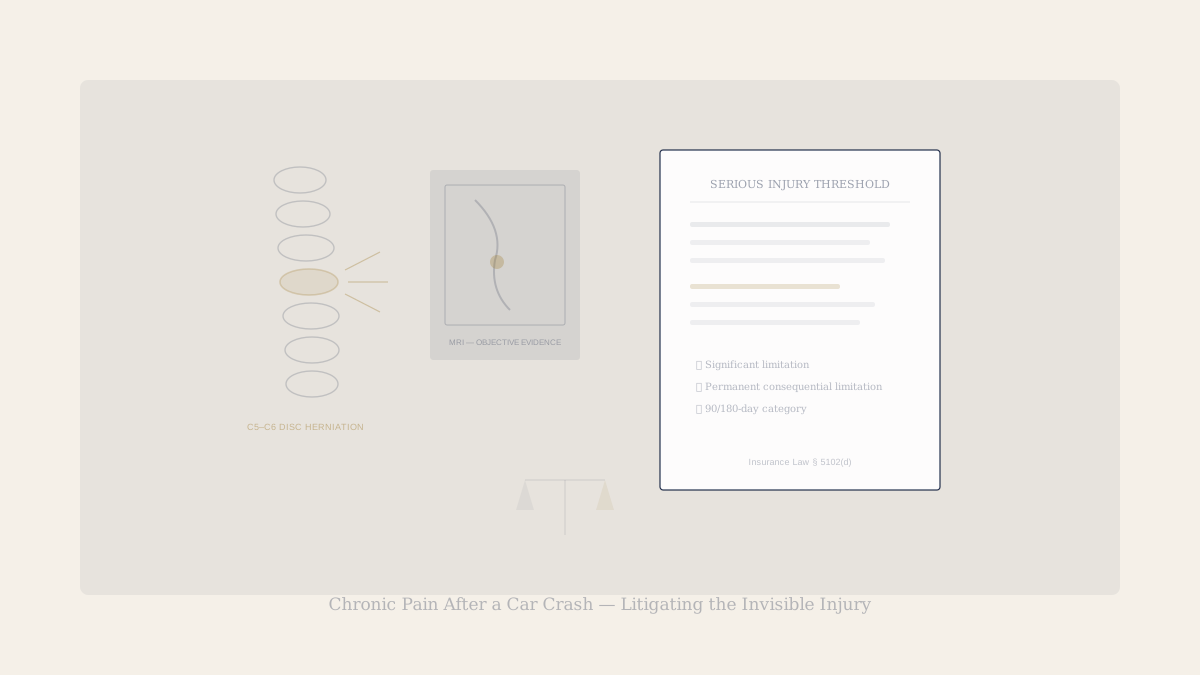
New York is a no-fault state. After a crash, your own insurer pays medical bills and lost wages up to $50,000 in basic economic loss regardless of fault — but to sue the at-fault driver for pain and suffering, you must first prove a “serious injury” as defined by Insurance Law § 5102(d).
Chronic pain cases typically travel through three of the statutory categories:
- Significant limitation of use of a body function or system — a meaningful, medically documented restriction (for example, quantified loss of cervical range of motion with radiating nerve pain)
- Permanent consequential limitation of use of a body organ or member — the same concept with proof of permanence, usually established after maximum medical improvement
- The 90/180-day category — a medically determined injury that prevented substantially all usual daily activities for at least 90 of the first 180 days after the accident
The threshold is where chronic pain cases are won or lost. Defendants move for summary judgment on the threshold in a large share of New York auto cases, and a plaintiff whose file contains only subjective complaints — “patient reports pain” — will not survive the motion.
The Evidence Rule That Shapes Everything: Objective Proof
In Toure v. Avis Rent A Car Systems (2002), the New York Court of Appeals set the standard that governs every chronic pain case: subjective complaints of pain, standing alone, are not enough. The injury must be supported by objective medical evidence. In Perl v. Meher (2011), the court added a practical refinement — the quantified measurements need not all be taken immediately after the crash, and a physician’s qualitative assessment can suffice — but the objective anchor remains mandatory.
In practice, attorneys build the objective record from these sources:
- MRI and CT imaging — herniated and bulging discs, nerve root impingement, annular tears
- EMG and nerve conduction studies — electrodiagnostic confirmation of radiculopathy, the nerve damage that turns a disc finding into documented radiating pain
- Quantified range-of-motion testing — degrees of restriction measured with instruments and compared to normal values, recorded at intervals across the treatment history
- Positive clinical findings — straight-leg raise, Spurling’s sign, muscle spasm palpated and noted by the examining physician
- Treatment escalation — physical therapy, trigger point and epidural steroid injections, radiofrequency ablation, and surgical recommendations, each corroborating that the pain is real and refractory
The role of medical experts is decisive here: treating physicians and retained specialists must connect the objective findings to the crash, to the pain, and to concrete functional limitations — what the client can no longer lift, how long they can no longer sit, the work they can no longer perform.
The Conditions Behind Chronic Pain Claims
Disc Injuries and Radiculopathy
The workhorse of chronic pain litigation. Cervical (neck) and lumbar (low back) disc herniations compress nerve roots, producing pain that radiates into the shoulders, arms, hips, or legs, with numbness and weakness. The combination of an MRI-documented herniation plus a positive EMG is the strongest common evidence package in this field.
Whiplash That Never Resolves
Most whiplash (cervical strain/sprain) resolves in weeks. A meaningful minority of patients develop chronic whiplash-associated disorder — persistent neck pain, stiffness, and headaches lasting years. These cases demand careful documentation precisely because the defense will characterize them as “soft tissue only.”
Post-Traumatic Headaches and TBI
Chronic headaches frequently follow concussion. When paired with cognitive symptoms, vestibular problems, or neuropsychological testing deficits, the claim becomes a mild traumatic brain injury case — a distinct and often substantial category of damages.
Complex Regional Pain Syndrome (CRPS)
CRPS is a severe neurological pain condition, usually in a limb after trauma, marked by burning pain disproportionate to the original injury, skin and temperature changes, and extreme sensitivity. It is disabling, medically recognized, and — because its diagnostic criteria are clinical — heavily contested by insurers. CRPS cases turn on early specialist diagnosis and meticulous documentation of the objective signs.
Aggravation of Pre-Existing Conditions
Many chronic pain plaintiffs are over 40, and almost every adult spine shows some degeneration on MRI. New York law is settled that a defendant takes the plaintiff as they find them: activating or aggravating a previously asymptomatic condition is compensable. The litigation battle is proving the “previously asymptomatic” part — which is why prior medical records, work histories, and before-and-after witnesses matter so much.
The Defense Playbook — and How Attorneys Beat It
“It's Just Degeneration”
The defense radiologist reads the same MRI and attributes every finding to age. The counter: records showing no prior complaints, testimony from the people who knew the plaintiff before the crash, and physician opinions distinguishing acute traumatic findings (edema, annular tears, focal herniations at the level matching the symptoms) from diffuse age-related change.
The Independent Medical Examination
Under CPLR § 3121, the defense is entitled to have its chosen doctor examine the plaintiff. The IME report in a chronic pain case is predictable: full range of motion, no objective findings, injuries “resolved.” Attorneys prepare clients for the exam, document its brevity, and attack the report through cross-examination — the doctor’s volume of defense work, the minutes actually spent with the patient, and the findings the report ignored.
Gaps in Treatment
An unexplained gap in treatment is one of the few things that can sink an otherwise strong chronic pain case at the threshold stage. Courts accept documented explanations — exhausted no-fault benefits, a physician’s conclusion that further care would be merely palliative — but the explanation must be in the record. This is also why insurance carriers benefit from delay: the longer a case drags while a claimant loses access to treatment, the more the record erodes.
Surveillance and Social Media
Chronic pain defendants routinely commission surveillance and scrape social media for the plaintiff carrying groceries or smiling at a barbecue. Attorneys prepare clients for this reality: live consistently with your limitations, and stay off social media. A chronic pain claim does not assert that the plaintiff can never move — but a jury shown a contradiction will forgive nothing.
Proving Damages: Translating Pain Into a Verdict
Once past the threshold, the case becomes about value. Chronic pain damages include past and future medical expenses (pain management is often lifelong — injections, medication, imaging, possible surgery), lost earnings and diminished earning capacity for clients whose work requires physical capacity or sustained concentration, and pain and suffering — past and future.
The strongest presentations make the invisible visible: deposition testimony that is specific and consistent, day-in-the-life evidence, testimony from spouses and coworkers who describe the before-and-after, and life-expectancy tables that force the jury to multiply daily suffering across decades. A 40-year-old with permanent chronic pain is not describing a bad year — they are describing the next forty.
What to Do If You Have Chronic Pain After a Crash
- File your no-fault application within 30 days — missing it can forfeit the medical benefits that fund your treatment. See our guide to filing an auto insurance claim in New York
- Report every symptom to every provider, every visit — the medical record is the case; symptoms that go unmentioned effectively did not happen
- Follow the treatment plan without gaps — and if treatment must pause, get the reason documented
- Preserve evidence — photographs, the police report, witness information, and dash cam footage if any exists
- Stay off social media — assume every post will be an exhibit
- Consult an attorney early — the three-year statute of limitations under CPLR § 214(5) (and far shorter municipal deadlines) run whether or not the pain has “settled down,” and the objective record that wins these cases is built at the beginning, not reconstructed at the end. Our overview of the personal injury case timeline shows how each phase unfolds
Talk to a New York Car Accident Attorney About Your Chronic Pain
Chronic pain cases reward preparation and punish improvisation. Yazdi Law represents car accident victims throughout New York City, Long Island, and Westchester — building the objective medical record, working with treating physicians and retained experts, and litigating the serious injury threshold that chronic pain cases must clear. The firm handles car accidents, truck accidents, rideshare accidents, and the full range of personal injury claims, on a contingency fee basis — you pay nothing unless we recover for you. Consultations are free and available in English and Farsi, including for members of the Iranian-American community.
Call (917) 565-7286 or use the form below. If chronic pain has followed you home from a crash, the time to build your case is now.