
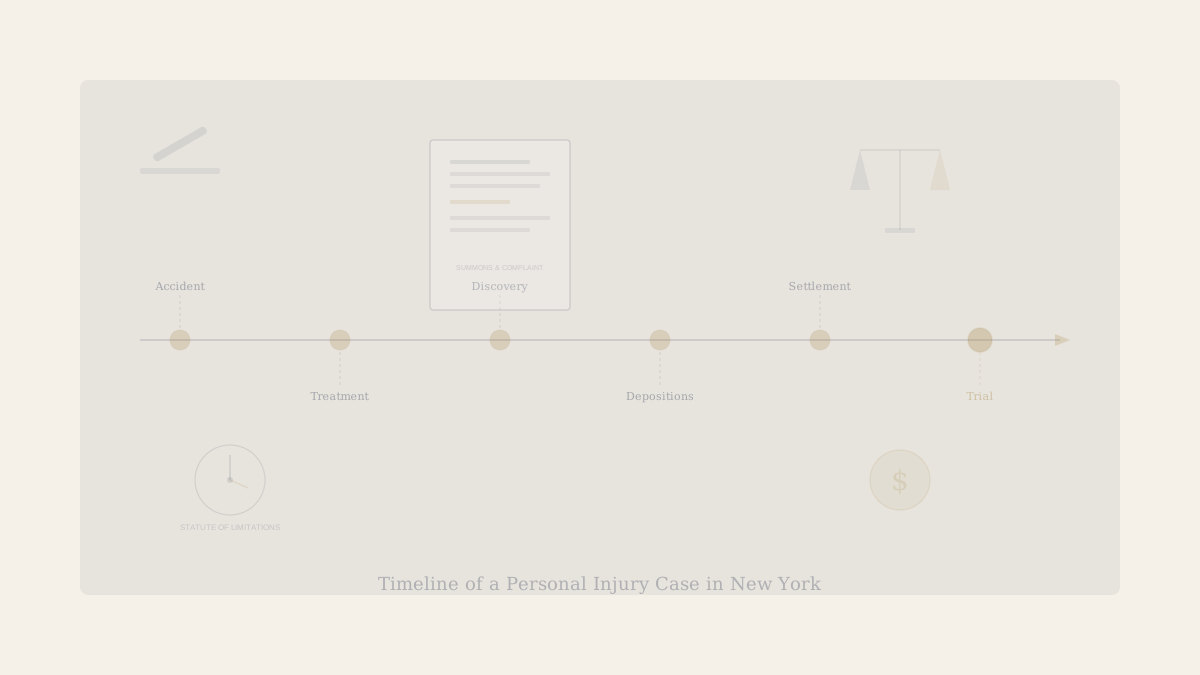
One of the first questions clients ask after an accident is: how long will this take? It is a fair question, and the honest answer is that personal injury cases in New York do not follow a single fixed schedule. A straightforward car accident case with clear liability and moderate injuries may resolve in 12 to 18 months. A complex construction accident claim involving multiple defendants, disputed liability, and serious injuries can take three years or longer. A case that goes to trial can take even more time.
What every personal injury case does share is a general sequence of stages — from the accident itself through medical treatment, insurance claims, litigation, and eventual resolution by settlement or trial. Understanding this timeline helps clients make informed decisions, set realistic expectations, and avoid the mistakes that delay or damage a case.
This post walks through each stage of a New York personal injury case in the order it typically occurs, with approximate timeframes and the key developments at each phase.
Stage 1: The Accident and Immediate Aftermath (Day 1 – Week 1)
The timeline begins the moment the accident happens. What you do in the first hours and days after an injury matters more than most people realize.
Preserve Evidence
Critical evidence can disappear quickly. Surveillance camera footage from nearby businesses is typically overwritten within days or weeks. Witness memories fade. Physical conditions at the scene change. If you are able, photograph the accident scene, your injuries, and any contributing conditions (a broken sidewalk, a missing construction safety barrier, a defective product). Get the names and contact information of witnesses. If you were in a car accident, file an accident report and obtain the other driver’s insurance information. If you were injured at a construction site, report the incident to your supervisor and ensure it is documented. Dash cam footage, if available, can be critical evidence in vehicle accident cases.
Seek Medical Attention
Go to the emergency room, urgent care, or your primary care physician as soon as possible after the accident. Delaying medical treatment creates two problems: first, the defense will argue that your injuries were not serious enough to warrant immediate care; second, a gap between the accident and your first medical visit makes it harder to prove that the accident caused your injuries. Even if your symptoms seem minor at first, many serious injuries — including herniated discs, torn ligaments, and traumatic brain injuries — may not manifest fully for days after the initial trauma.
Contact a Personal Injury Attorney
There is no downside to consulting an attorney early. Your attorney can send evidence preservation letters, begin investigating the accident, communicate with insurance companies on your behalf (preventing you from making damaging statements), and advise you on protecting your rights from the outset. Most personal injury attorneys in New York, including Yazdi Law, offer free consultations and work on a contingency fee basis — you pay nothing unless the case is successful.
Stage 2: Medical Treatment (Weeks 1 – 12+ Months)
The medical treatment phase is typically the longest single phase of a personal injury case, and it is also the most important for the value of your claim. Your medical records are the primary evidence of your injuries.
Follow Your Treatment Plan
Follow your doctors’ recommendations. Attend all scheduled appointments. Complete the prescribed course of physical therapy, follow-up visits, specialist consultations, and any recommended diagnostic imaging (MRIs, CT scans, X-rays). Gaps in treatment are one of the most powerful tools the defense has to reduce the value of your case. If you stop treating for a period of time, the defense will argue that your injuries were not serious — regardless of the actual reason for the gap.
Reaching Maximum Medical Improvement
Your attorney will generally not attempt to settle your case until you have reached maximum medical improvement (MMI) — the point at which your condition has stabilized and your doctors can assess whether you have any permanent injuries or limitations. Settling before MMI is risky because you may not yet know the full extent of your injuries, and once you settle, you cannot go back and ask for more money. The timeline to MMI varies widely: a soft tissue injury may reach MMI in three to six months, while a serious orthopedic injury requiring surgery may take a year or more.
The role of medical evidence in personal injury cases cannot be overstated. Medical experts may be needed to establish causation, the necessity of treatment, and the permanence of your injuries — particularly when the defense challenges any of these elements.
Stage 3: The Insurance Claim and Pre-Litigation Demand (Months 3 – 12)
While you are still treating, your attorney is building your case file. Once treatment is complete or you have reached MMI, your attorney will prepare a demand package and submit it to the at-fault party’s insurance carrier.
What the Demand Package Contains
A demand package typically includes a detailed demand letter setting forth the facts of the accident, the legal basis for liability, a summary of your injuries and medical treatment, your total economic damages (medical bills, lost wages), a claim for non-economic damages (pain and suffering), and supporting documentation — medical records, bills, photographs, accident reports, and any expert reports.
Insurance Company Response
After receiving the demand, the insurance company will review the claim, often request additional records, and eventually make a settlement offer. Insurance companies frequently delay the claims process as a negotiating tactic — the longer the process takes, the more financial pressure builds on the injured person to accept a low offer. Your attorney negotiates with the carrier during this phase. If the carrier makes a fair offer that reflects the value of your injuries, the case settles here — without the need for a lawsuit. Many cases resolve at this pre-litigation stage.
If the insurance company refuses to make a reasonable offer, the next step is filing a lawsuit.
Stage 4: Filing the Lawsuit (Months 6 – 18)
If pre-litigation negotiations fail, your attorney files a summons and complaint in the appropriate New York court. For most personal injury cases in New York City, this is the Supreme Court of the county where the accident occurred or where the defendant resides. The complaint sets forth the factual allegations and legal claims against the defendant.
The Statute of Limitations
The lawsuit must be filed before the statute of limitations expires. The general statute of limitations for personal injury in New York is three years from the date of the accident under CPLR § 214(5). Critical exceptions include:
- Municipal claims: A Notice of Claim must be filed within 90 days under General Municipal Law § 50-e, and the lawsuit within one year and 90 days
- Medical malpractice: Two and a half years from the date of the malpractice under CPLR § 214-a
- Wrongful death: Two years from the date of death under EPTL § 5-4.1
- Minors: The statute is tolled until the minor turns 18, then the standard three-year period applies
Missing the statute of limitations is almost always fatal to the case. This is one of the most important reasons to consult an attorney promptly after an accident.
Service of Process and the Answer
After the complaint is filed, it must be served on the defendant(s). The defendant then has a set period — typically 20 to 30 days — to file an answer responding to the allegations. Once the answer is filed, the case is formally "at issue" and discovery can begin.
Stage 5: Discovery (Months 12 – 30)
Discovery is the formal exchange of information and evidence between the parties. It is typically the most time-consuming phase of the litigation and drives the overall timeline of the case.
Key Discovery Tools
- Bills of particulars: A detailed statement of your injuries, the theory of liability, and the damages you are claiming
- Interrogatories: Written questions that each side must answer under oath
- Document demands: Requests for medical records, employment records, insurance policies, photographs, text messages and electronic communications, and other relevant documents
- Depositions: Sworn, out-of-court testimony — the plaintiff, defendant, and key witnesses are each examined under oath. Deposition testimony is often the single most important event in the case short of trial
- Independent medical examination (IME): Under CPLR § 3121, the defense can require the plaintiff to be examined by a doctor of their choosing. Despite the name, the IME doctor is retained by the defense and frequently produces a report that minimizes the plaintiff’s injuries
How Long Discovery Takes
In straightforward cases, discovery can be completed in 12 to 18 months. In complex cases — construction accident cases with multiple defendants and contractors, truck accident cases involving corporate records and federal motor carrier regulations, or premises liability cases requiring building maintenance and inspection records — discovery can stretch to two years or more. Delays are common when parties fail to comply with discovery demands, requiring motion practice to compel disclosure.
Stage 6: Settlement Negotiations and Mediation (Months 18 – 36)
Settlement negotiations are ongoing throughout the case, but they intensify after discovery is complete and both sides have a full picture of the evidence.
Pre-Trial Settlement Conference
In New York, the court typically schedules a pre-trial conference at which a judge or court attorney will attempt to facilitate settlement. In some courts, cases are referred to mediation — a structured process where a neutral mediator works with both sides to reach a resolution. Mediation is not binding unless both sides agree to a settlement.
Evaluating Settlement Offers
Settlement is a business decision. Your attorney will evaluate offers based on the strength of the liability evidence, the severity and permanence of your injuries, the total economic damages (medical bills, lost wages, future medical costs), the likely range of jury verdicts for similar injuries in the relevant county, and the risks and costs of going to trial. A settlement provides certainty — a guaranteed amount without the risk of an unfavorable verdict. Trial offers the potential for a higher award but also the risk of receiving less — or nothing.
No-Fault Insurance in Car Accident Cases
In New York car accident cases, the injured party’s own no-fault insurance covers medical bills and lost wages up to $50,000 regardless of fault. To pursue a claim for pain and suffering damages against the at-fault driver, the plaintiff must demonstrate a "serious injury" as defined by Insurance Law § 5102(d). This threshold adds a layer of complexity to settlement negotiations in motor vehicle cases that does not apply in slip and fall or construction accident claims.
Stage 7: Trial (Months 24 – 48+)
If the case does not settle, it proceeds to trial. The vast majority of personal injury cases settle before reaching this stage — but having an attorney who is prepared and willing to try the case is essential, because insurance companies offer better settlements when they believe the plaintiff’s attorney will actually go to trial.
Trial Preparation
In the weeks before trial, your attorney prepares trial exhibits, finalizes witness lists, prepares opening and closing statements, and conducts a final trial preparation session with you. Expert witnesses — medical experts, accident reconstruction experts, economists for lost wage claims — are prepared for their testimony.
The Trial Itself
A personal injury trial in New York Supreme Court typically lasts three to ten days, depending on the complexity of the case. The trial follows a standard sequence: jury selection (voir dire), opening statements, the plaintiff’s case (your witnesses and evidence), the defendant’s case, closing arguments, jury instructions, and the verdict. The jury determines both liability (whether the defendant was negligent) and damages (the amount of compensation).
Post-Trial Motions and Appeals
After the verdict, either side may file post-trial motions to set aside the verdict or reduce the damages award. The losing party may also appeal to the Appellate Division. Post-trial proceedings can add months to years to the overall timeline, though most verdicts are upheld or resolved during this phase.
Factors That Affect the Timeline
Several factors can significantly shorten or lengthen the timeline of a personal injury case:
- Severity of injuries: More serious injuries require longer treatment periods before the case can be valued and resolved. A case involving a construction site fall with spinal surgery will take longer than a soft tissue injury from a fender bender
- Clarity of liability: Cases with clear liability (a rear-end collision, a fall on an obviously defective stairway) resolve faster than cases where fault is disputed
- Number of defendants: Cases with multiple defendants — common in construction accident and truck accident cases — involve more discovery, more depositions, and more coordination, all of which extend the timeline
- Court backlog: Trial delays due to court congestion vary by county. New York County (Manhattan) and Kings County (Brooklyn) typically have longer trial wait times than less congested counties
- Insurance carrier strategy: Some insurance carriers delay cases deliberately as a negotiation tactic, stretching out the process to pressure plaintiffs into accepting lower settlements
- Comparative negligence: Under CPLR § 1411, New York applies a pure comparative negligence standard — your recovery is reduced by your percentage of fault, but you can still recover even if you are more than 50% at fault. Disputed comparative negligence adds complexity and can extend negotiations
What You Can Do to Keep Your Case on Track
While much of the timeline is outside your control, there are specific steps you can take to avoid unnecessary delays:
- Do not delay medical treatment. Seek care immediately after the accident and follow your treatment plan consistently
- Keep records. Save all medical bills, receipts, correspondence with insurance companies, and documentation of lost wages
- Respond promptly to your attorney. Your attorney will need documents, information, and signatures throughout the case. Delayed responses from clients are one of the most common causes of avoidable case delays
- Do not post about your case on social media. Defense attorneys and insurance adjusters routinely monitor social media accounts for posts that contradict injury claims
- Be honest with your attorney. Disclose prior injuries, prior accidents, and any facts that could affect your case. Surprises that emerge during discovery are far more damaging than information disclosed to your attorney upfront
Contact Yazdi Law About Your Personal Injury Case
If you have been injured in an accident in New York, understanding the timeline of your case is the first step toward making informed decisions. Yazdi Law represents injured individuals throughout New York City and the surrounding counties in car accidents, slip and fall injuries, construction accidents, truck accidents, rideshare accidents, and other personal injury claims. We also serve the Iranian-American community and Punjabi-speaking community with consultations available in Farsi and Punjabi.
Call (917) 565-7286 or use the form below to schedule a free consultation. We handle personal injury cases on a contingency fee basis — you pay nothing unless we recover compensation for you.