
When a marriage ends because of an affair, one of the first questions the betrayed spouse asks a divorce attorney is some version of: “Will the cheating count against them?” And the spouse who strayed asks the mirror image: “Will I be punished financially?”
The honest answer surprises almost everyone. In New York, infidelity almost never affects alimony — which New York law calls spousal maintenance. Maintenance is calculated by an income-based statutory formula, and marital fault is not part of the equation. But that headline rule has important exceptions and edges: money spent on an affair can absolutely be recovered, truly extreme misconduct can change the financial outcome, and the strategic decisions an affair triggers — when to file, what to document, whether to pursue fault grounds — can meaningfully affect how a divorce unfolds.
This post explains exactly how New York law treats infidelity in divorce: the maintenance formula, the fault rules, the egregious conduct exception, the wasteful dissipation doctrine, and what to do practically if an affair is part of your divorce.
New York Is a No-Fault State — and the Formula Doesn't Ask Why
Since 2010, New York has permitted no-fault divorce under Domestic Relations Law § 170(7): either spouse may obtain a divorce by stating under oath that the marriage has been irretrievably broken for at least six months. No proof of misconduct is required, and the overwhelming majority of New York divorces — including divorces precipitated by affairs — proceed on this ground, whether as an uncontested divorce or a contested one.
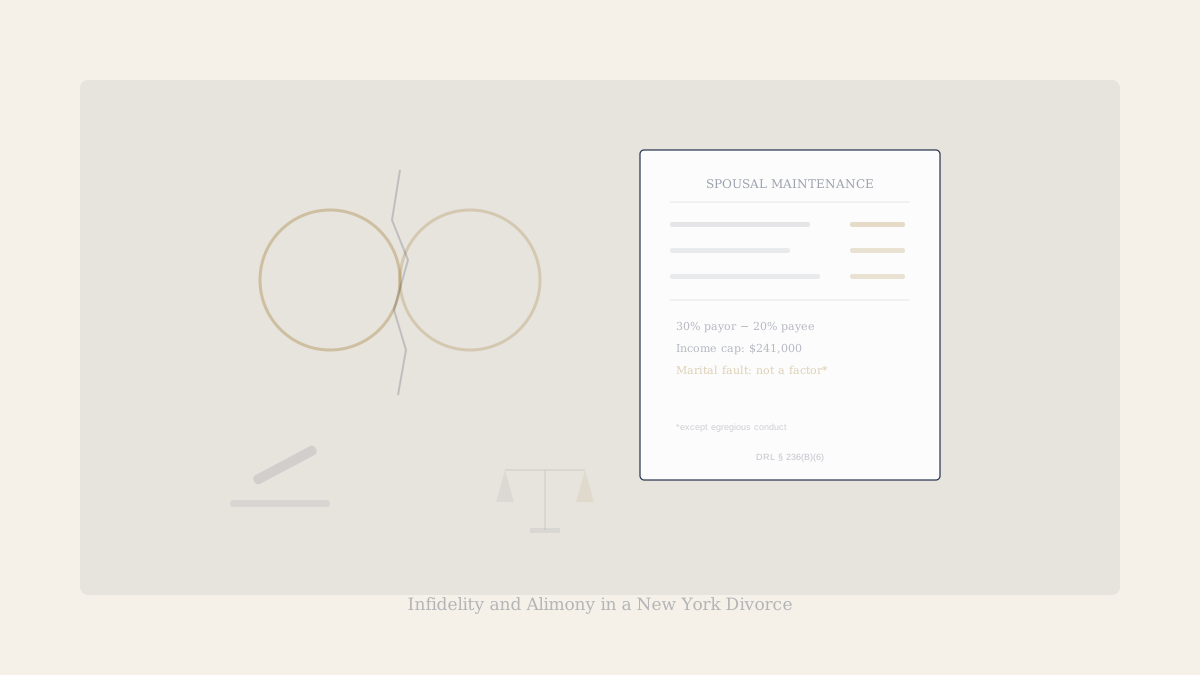
Spousal maintenance follows the same fault-blind logic. Under DRL § 236(B), post-divorce maintenance is calculated by a guideline formula based on the parties’ incomes:
- Without child support: 30% of the payor’s income minus 20% of the payee’s income
- With child support (payor also paying child support to the same recipient): the lesser of (a) 20% of payor income minus 25% of payee income, or (b) 40% of the combined income minus the payee’s income
The formula applies to the first $241,000 of the payor’s income — the cap in effect for 2026, adjusted every two years for inflation. For income above the cap, and for deviations from the guideline, the court weighs the statutory factors in DRL § 236(B)(6)(e): the age and health of the parties, earning capacity, the need to pay for education or training, the standard of living during the marriage, caregiving responsibilities, and more than a dozen others.
Read that factor list carefully and you will notice what is missing: fault. The legislature did not include adultery, abandonment, or cruelty among the maintenance factors. A spouse who cheated pays (or receives) the same guideline maintenance as a spouse who did not.
The Court of Appeals Has Settled the Question
This is not just a reading of the statute — New York’s highest court has addressed it directly. In Howard S. v. Lillian S. (2010), the Court of Appeals held that adultery, standing alone, does not constitute the kind of “egregious conduct” that permits a court to alter the financial incidents of a divorce. The court reaffirmed the standard from Blickstein v. Blickstein: marital fault may be considered only where the conduct is “so egregious or uncivilized as to bespeak of a blatant disregard of the marital relationship.”
What has met that standard in reported cases? Attempted murder of a spouse. Vicious assaults. Conduct at the outer extreme of human behavior. What has not met it? Affairs — even long-running ones, even affairs with profound emotional consequences for the family. The courts’ reasoning is institutional as much as moral: if ordinary fault affected money, every divorce would become a trial about the marriage’s failures, which is precisely what the no-fault reform was designed to end.
Where Infidelity DOES Matter Financially: Wasteful Dissipation
Here is the exception that matters in real cases. While the fact of an affair does not change the financial outcome, the money spent on it does.
Marital funds are joint property. When one spouse spends marital money on a non-marital purpose — and an affair is the textbook example — that spending is wasteful dissipation of marital assets, an express factor in equitable distribution under DRL § 236(B)(5)(d). Courts routinely credit the innocent spouse for dissipated funds, effectively adding the spent money back into the marital estate and charging it against the spending spouse’s share.
Affair-related dissipation commonly includes:
- Travel and hotels — trips taken with a paramour, charged to marital credit cards
- Gifts — jewelry, electronics, designer goods purchased for the affair partner
- Housing — rent, furniture, or utilities paid on an apartment for the paramour
- Cash transfers — Venmo, Zelle, and wire transfers to or for the affair partner
- Support of a second household — in long-running affairs, sometimes years of documented spending
Two practical points follow. First, documentation wins these claims: bank statements, credit card records, and — in significant cases — a forensic accountant who traces the spending. If you suspect affair-related dissipation, preserve financial records immediately and tell your attorney before accounts are closed or statements become harder to obtain. Second, dissipation is a property-division doctrine, but its effect can ripple into maintenance: the statutory factors include the equitable distribution award and “any other factor” the court finds just and proper, so a substantial dissipation finding shapes the overall financial picture the court is balancing.
Adultery as a Divorce Ground: Technically Alive, Practically Retired
Adultery remains a fault ground for divorce under DRL § 170(4), and some betrayed spouses instinctively want to file on it. It is almost never the right strategy, for three reasons:
- Proof is hard. New York law does not allow a divorce to be granted on the adulterous spouse’s admission alone — corroborating evidence is required, which historically meant private investigators and circumstantial proof of opportunity and inclination
- Defenses exist. Condonation (you learned of the affair and continued the marriage), connivance, recrimination, and a five-year limitations period can each defeat an adultery claim
- Winning gets you nothing extra. Because fault does not affect maintenance, property division, or custody, a successful adultery claim produces the same financial outcome as a no-fault divorce — after months of additional litigation, expense, and painful testimony
A footnote for the curious: adultery was even a crime in New York — a class B misdemeanor under Penal Law § 255.17 — until the legislature repealed the statute in November 2024. The repeal changed nothing in divorce court, but it captures the direction of New York law: infidelity is treated as a personal wrong, not a legal one.
Infidelity and Child Custody
Parents often assume an affair will count against the other parent in a custody dispute. New York courts decide custody under the best interests of the child standard, and a parent’s infidelity is not, by itself, evidence of parental unfitness. Judges look at the conduct’s effect on the children, not on the marriage. An affair becomes custody-relevant only through its consequences — a parent who repeatedly left young children unsupervised to meet a paramour, exposed the children to inappropriate situations, or destabilized the children’s lives in the process. Absent that, courts treat the affair as an issue between the adults.
Can You Contract Around the Rule? Infidelity Clauses in Prenups
Some couples ask whether a prenuptial agreement can do what the statute will not — impose a financial penalty for cheating. These “lifestyle clauses” make headlines in celebrity divorces, but in New York their enforceability is doubtful. A fault penalty invites exactly the litigation New York’s no-fault framework exists to prevent, and no New York appellate court has squarely enforced one. A prenup’s real power lies elsewhere: designating separate property, setting maintenance terms with established enforceability, and protecting businesses and inheritances — outcomes that do not depend on proving what happened inside the marriage.
What to Do If Infidelity Is Part of Your Divorce
If you are the betrayed spouse:
- Understand early that the affair itself will not increase your maintenance — calibrating expectations prevents costly strategic mistakes
- Preserve financial records and flag suspicious spending for your attorney; the dissipation claim is where the affair has real financial teeth
- Do not use self-help surveillance that could violate wiretapping or computer-access laws — illegally obtained evidence can backfire, and in some cases creates liability
- File on no-fault grounds unless your attorney identifies a specific strategic reason not to
If you had the affair:
- The law does not financially punish the affair — but dissipation is a genuine exposure. Be candid with your attorney about affair-related spending so it can be addressed rather than discovered
- Do not delete messages or financial records once divorce is contemplated; destruction of evidence is far more damaging than the evidence itself
- Recognize that guilt-driven settlement decisions — giving away more than the law requires — are common and rarely wise. Settle on the law and the numbers
For both spouses: the affair usually matters most in how the divorce is conducted, not what it yields. High-conflict fault narratives drive up fees and prolong cases. An experienced New York divorce attorney channels the case toward the issues that actually move the outcome: income, assets, dissipation, custody arrangements, and support.
Talk to a New York Divorce Attorney About Your Situation
Every divorce involving infidelity carries a version of the same tension: what the law weighs and what the heart weighs are different things. Yazdi Law represents spouses on both sides of that divide throughout New York City and Long Island — in uncontested divorces, contested litigation involving dissipation and complex finances, custody matters, and prenuptial and postnuptial agreements. Consultations are available in English and Farsi, including for Iranian-American clients whose divorces involve mahr (mehrieh) obligations alongside New York maintenance law.
Call (917) 565-7286 or use the form below for a confidential consultation about how New York’s maintenance and property rules apply to your specific circumstances.