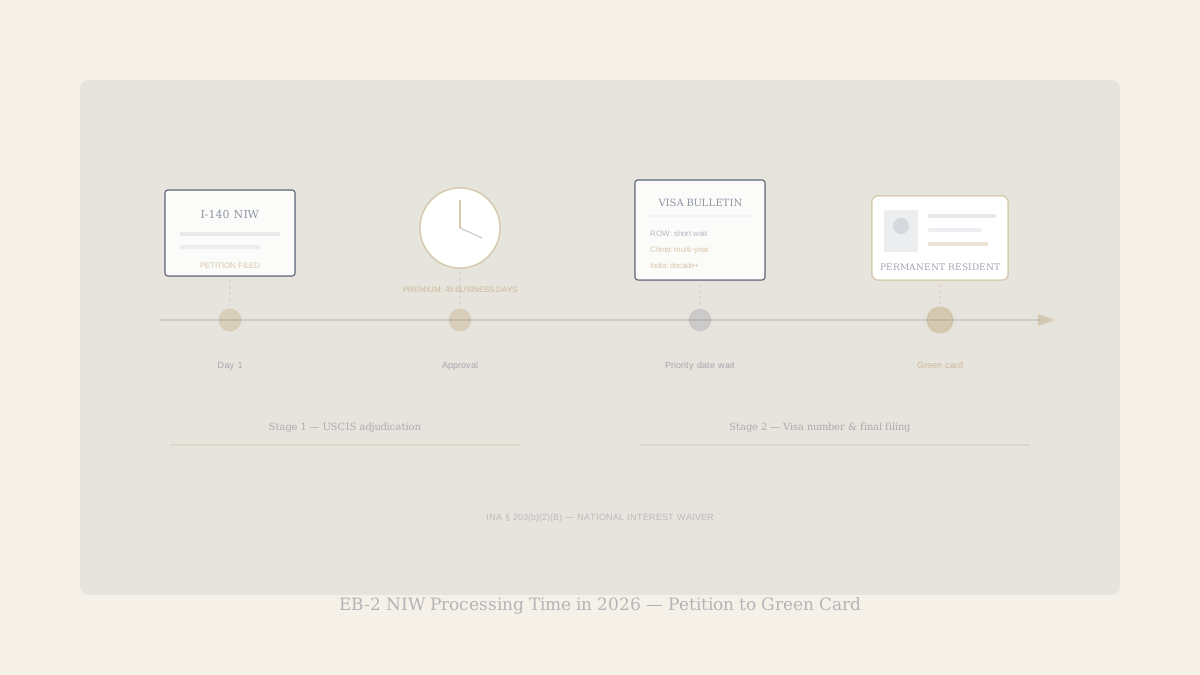
Ask how long an EB-2 National Interest Waiver takes, and you will get answers ranging from “two months” to “fifteen years” — and all of them can be true. The confusion comes from collapsing two very different clocks into one question. The NIW timeline has two stages: how long USCIS takes to approve your I-140 petition, and how long you wait for a visa number under the Department of State’s monthly Visa Bulletin. The first stage you can largely control. The second depends almost entirely on where you were born.
This guide lays out the full 2026 timeline from petition to green card — the current USCIS processing data, the premium processing math, the visa bulletin reality for rest-of-world, China-born, and India-born applicants, and the strategies that compress the parts of the wait that can be compressed. (For what the NIW requires — the Dhanasar framework and evidence strategy — this article focuses on timing; our immigration practice overview and EB-1A page cover the adjacent categories.)
The NIW in One Paragraph
The National Interest Waiver, under INA § 203(b)(2)(B), is the EB-2 green card with the two slowest requirements waived: no job offer, no PERM labor certification. You self-petition by showing, under Matter of Dhanasar (2016), that your proposed endeavor has substantial merit and national importance, that you are well positioned to advance it, and that waiving the job-offer requirement benefits the United States. Skipping PERM alone saves a year or more compared to a standard employer-sponsored EB-2 — which is why the NIW has become the green card of choice for researchers, STEM professionals, physicians, and founders.
Stage One: The I-140 Petition (The Clock You Control)
Regular Processing: Measured in Years
With regular processing in 2026, USCIS has been reporting that 80% of NIW I-140 petitions are adjudicated within roughly 30 months — two and a half years of pendency before the petition is even decided. Individual service centers fluctuate, and many cases resolve faster, but planning around the published 80th-percentile figure is the honest approach.
Premium Processing: 45 Business Days for $2,965
The single highest-leverage decision in most NIW cases: USCIS premium processing is available for NIW I-140s at a fee of $2,965 (for requests postmarked on or after March 1, 2026), guaranteeing agency action within 45 business days — about nine weeks. Three caveats keep the guarantee honest:
- “Action” includes a Request for Evidence, which stops the clock until you respond — so a thin petition buys fast bad news, not a fast approval
- Premium processing accelerates only the I-140 — it does nothing about the visa bulletin
- You can file it with the petition or upgrade a pending regular case later — a useful tool for applicants already stuck in the queue
For most rest-of-world applicants, the ~$3,000 converts a multi-year stage one into two months. For backlogged nationalities, it still locks in the approval and priority date early — the raw material for every porting strategy discussed below.
Stage Two: The Visa Bulletin (The Clock You Don't)
An approved I-140 is a place in line, not a green card. Federal law caps employment-based green cards each year and limits any single country of birth to about 7% of the pool. The monthly Visa Bulletin publishes cutoff dates; your priority date — the day USCIS received your I-140 — must be earlier than the posted cutoff before you can complete the final stage.
As of the November 2026 Visa Bulletin, EB-2 final action dates stand at:
- Rest of world (most countries, including Iran): April 1, 2025 — a queue currently running on the order of a year to two, and advancing
- China (mainland-born): October 1, 2021 — a multi-year backlog
- India: November 1, 2013 — a wait currently exceeding a decade
Two features of the bulletin matter strategically. First, country of birth controls, not citizenship — a Canadian citizen born in India is charged to India, while a spouse’s different country of birth can sometimes be borrowed (cross-chargeability). Second, the bulletin has two charts: Final Action Dates (when the green card can be approved) and the typically more generous Dates for Filing (when USCIS, in months it honors that chart, will accept your I-485) — and the gap between them is where interim benefits live.
The Final Stage: I-485 or Consular Processing
Adjustment of Status (Inside the U.S.)
Applicants lawfully in the United States file Form I-485 once the bulletin permits — concurrently with the I-140 if the priority date is already current. Filing the I-485 unlocks the benefits that make long waits livable: an employment authorization document and advance parole travel permission, renewable for the life of the case. Adjustment itself typically adds roughly a year, sometimes more, including biometrics, the medical examination, and — when scheduled — an interview at the local field office. Our guide to navigating USCIS covers the mechanics that apply across these filings.
Consular Processing (Abroad)
Applicants outside the U.S. proceed through the National Visa Center to an immigrant visa interview at a U.S. consulate — generally adding several months after the priority date becomes current. For Iranian nationals, interviews occur in third countries — Abu Dhabi, Ankara, Yerevan — because no U.S. embassy operates in Iran, and administrative processing under INA § 221(g) routinely adds weeks to months for Iranian applicants. These realities belong in the timeline plan from day one, not discovered at the interview window.
Realistic End-to-End Timelines in 2026
- Rest of world, premium processing, in the U.S.: I-140 in ~2 months; I-485 filed as the date becomes current; green card in roughly 1 to 3 years from filing
- Rest of world, regular processing: add up to ~2.5 years of I-140 pendency to the front — the strongest argument for premium processing there is
- China-born: I-140 fast with premium; total timeline governed by a multi-year bulletin wait — EB-1A upgrade strategies matter here
- India-born: the I-140 is the easy part; the EB-2 queue currently implies a decade-plus wait, making the NIW chiefly a priority-date anchor while AC21 H-1B extensions, porting, and EB-1A qualification carry the practical burden
Seven Ways to Compress the Timeline
- File premium processing — the best ~$3,000 in employment immigration for nearly every NIW case
- Avoid the RFE — a petition mapped exhibit-by-exhibit to the three Dhanasar prongs the first time saves the months an RFE costs; this is where experienced counsel pays for itself
- File as early as possible — the priority date is the asset; every month of delay is a month added to the back of the line
- Watch both bulletin charts monthly — and file the I-485 the moment the Dates for Filing chart opens in a month USCIS honors it
- Prepare the final-stage documents in advance — civil documents, translations, and the medical exam ready before the date is current, not scrambled after
- Maintain your nonimmigrant status — the pending NIW confers nothing; your H-1B, O-1, or STEM OPT is what keeps you lawfully present and working through stage one
- Build the EB-1A in parallel — for backlogged countries especially, the NIW anchors the priority date while a maturing record (publications, citations, judging, press) supports a later EB-1A petition that inherits the earlier date and jumps the queue
NIW, O-1, EB-1A: The Portfolio View
The NIW rarely stands alone in a well-planned case. Professionals ineligible for the H-1B lottery or tired of its odds work in O-1 status while the NIW pends. Strong researchers file the NIW early for the priority date, then EB-1A when the record supports it. Physicians weigh the NIW’s five-year underserved-area variant. The common thread: the petition you file first is a strategic choice about clocks — USCIS’s, the State Department’s, and your career’s — and the right sequence depends on your country of birth, your current status, and how your evidence will age.
Talk to a New York Immigration Attorney About Your NIW Timeline
An honest NIW consultation answers three questions: whether your record meets Dhanasar today, how long your timeline actually runs given your country of birth and status, and whether a parallel or alternative petition serves you better. Yazdi Law prepares NIW, EB-1A, O-1, and H-1B cases for researchers, engineers, physicians, and founders from our office at 261 Madison Avenue in Midtown Manhattan — with particular depth in cases involving Iranian nationals, where consular strategy and administrative processing planning are part of the case from the first meeting. Consultations are available in English, Farsi, and Punjabi.
Call (917) 565-7286 or use the form below. The priority date you lock in this year is the one you will be glad you have in three.