
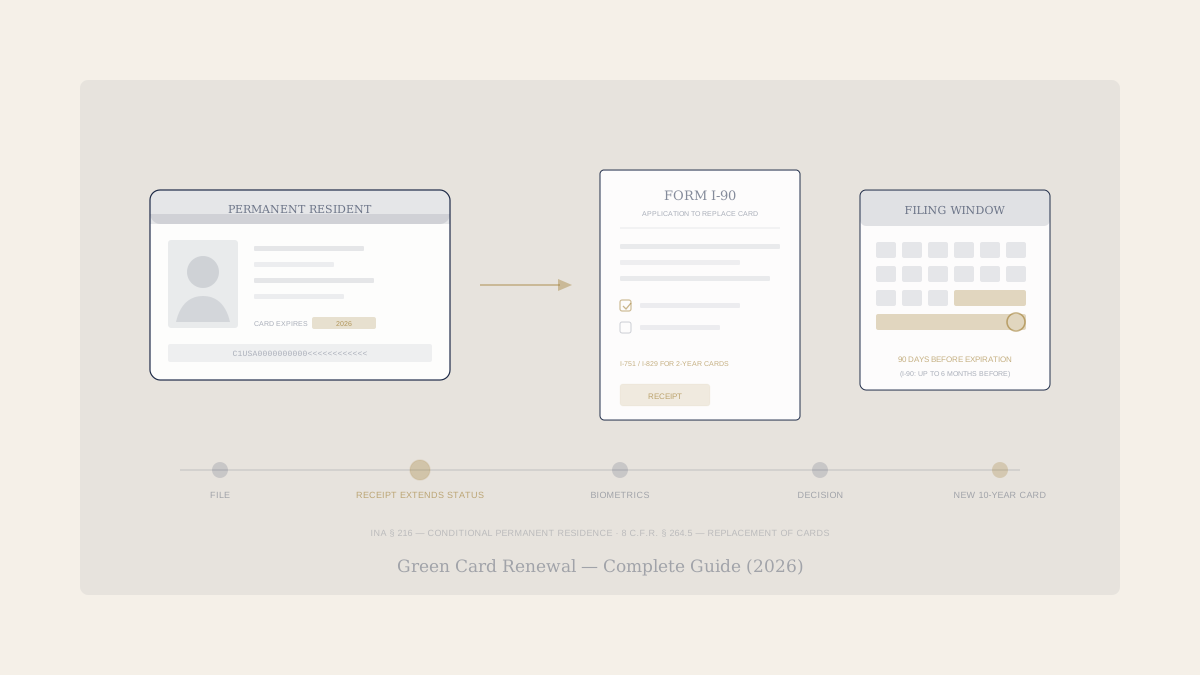
Green card renewal sounds like paperwork, and for most holders of a 10-year card it is: file Form I-90, pay the fee, give fingerprints, wait for the new card. But the phrase covers two very different situations. A permanent resident with a 10-year card is replacing a document; their status never expires. A conditional resident with a 2-year card is not renewing anything — they must petition on Form I-751 (marriage) or Form I-829 (investment) to remove the conditions on their residence, within a 90-day window, or their status ends by operation of law. Confusing the two is the single most damaging mistake in this area.
This guide covers both paths as they stand in November 2026: who files which form, the current USCIS fees, how early you can file, what the receipt notice does for you while you wait, current processing times, what happens when a card expires, travel with an expired card, the waivers available when a marriage has ended, when naturalization is the better move, and when a renewal filing can put a permanent resident at risk. It is written by a New York City immigration attorney whose firm handles I-90, I-751, and N-400 matters for clients across the five boroughs, Long Island, and nationwide.
Green Card Renewal at a Glance: I-90 vs. I-751 vs. I-829
| Form I-90 (10-year card) | Form I-751 (2-year marriage card) | Form I-829 (2-year investor card) | |
|---|---|---|---|
| Who files it | Holders of 10-year cards (expiring, expired, lost, stolen, damaged, name change, or error) | Conditional residents with a 2-year marriage-based card | Conditional residents with a 2-year EB-5 investor card |
| When to file | Up to 6 months before expiration, or any time after | In the 90 days before the card expires (waivers: any time) | In the 90 days before the card expires |
| USCIS fee (2026) | $415 online / $465 by mail | $750 | $9,525 |
| Receipt notice extends status | 36 months past the card’s expiration date | 48 months past the card’s expiration date | 48 months past the card’s expiration date |
| Current processing (Nov. 2026) | About 10.5 months for 80% of cases; FY 2026 median 8.5 months | About 35–36 months for 80% of cases; FY 2026 median 22.2 months | Commonly two years or more |
| If you miss the deadline | Status continues; you lack valid proof of it | Conditional status terminates automatically; removal proceedings may follow | Conditional status terminates automatically |
Fees reflect the USCIS fee schedule in effect for 2026; processing figures are from the USCIS processing times tool and historical data as reported in November 2026. Both change, and both should be confirmed on uscis.gov before you file.
Which Card Do You Have? Why It Decides Everything
Look at the expiration date on the front of your card and at the category code on the back or front.
- A 10-year card is issued to lawful permanent residents whose status carries no conditions. The card expires; the status does not. You renew the card with Form I-90.
- A 2-year card marks conditional permanent residence under INA § 216 (marriage-based, categories such as CR1, CR6, CF1, CF2) or INA § 216A (EB-5 investor, categories such as C51 to C58). Conditions must be removed by petition; there is no renewal.
- A card with no expiration date was issued between 1979 and 1989 and remains valid evidence of status, although USCIS has long encouraged replacement, and many agencies and employers will not accept it. Form I-90 is used to replace it.
USCIS says it plainly on the I-90 instructions: do not file Form I-90 if you are a conditional resident seeking to remove conditions. A conditional resident who files I-90 by mistake pays a fee for a rejection and, worse, may let the 90-day I-751 window close while waiting.
Part One: Renewing a 10-Year Green Card With Form I-90
When to File Form I-90
You may file to renew an expiring card up to six months before the expiration date, and you may file at any time after the card has expired. Filing earlier than six months risks rejection. Form I-90 is also the form for a card that was lost, stolen, or destroyed; a card that was never received after approval; a card with a USCIS error in your name, date of birth, or photograph (no fee if the error was the agency’s); a legal name change; a child who turns 14 and must be re-fingerprinted; and the pre-1989 cards without an expiration date.
How to File: Online or by Mail
Most applicants should file online through a USCIS account. It costs $50 less ($415 versus $465), produces an instant receipt, lets you upload evidence and respond to notices electronically, and shows case status in one place. File on paper if you are requesting a fee waiver, which cannot be submitted online, or if your situation requires explanatory evidence that is easier to present in a mailed package. The current form edition is dated 01/20/25; USCIS rejects filings on an outdated edition, so download the form fresh from uscis.gov rather than reusing a saved copy.
What to Include
- A copy of the front and back of your current or expired card (or, if lost, a government-issued photo ID and a police report or sworn statement about the loss)
- Evidence supporting the reason for replacement: the court order or marriage certificate for a name change; documents showing the error for a correction
- The filing fee, or Form I-912 with supporting financial documents for a fee waiver
- Your A-number, your current address, and an accurate travel and address history where the form asks for it
After You File: Receipt, Biometrics, Card
- Receipt notice (Form I-797C). Issued within days for online filings and within a few weeks for mailed filings. Keep the original; it is now part of your proof of status.
- Biometrics. USCIS either schedules an appointment at an Application Support Center (in New York City, commonly 201 Varick Street or a borough ASC) or reuses fingerprints already on file. Missing a biometrics appointment without rescheduling can lead to denial for abandonment.
- Decision and card production. As of November 2026, USCIS reports completing 80% of I-90s in about 10.5 months, with a fiscal year 2026 median of 8.5 months. The card is mailed by USPS to the address on file; a move without a filed Form AR-11 is the most common reason a card is returned as undeliverable.
The 36-Month Automatic Extension
Since September 2024, the I-90 receipt notice has stated that it extends the validity of the applicant’s card for 36 months beyond the expiration date printed on the card. Presented together with the expired card, the receipt notice is acceptable for employment verification on Form I-9, for travel and reentry, and for most state agency purposes. The 36 months run from the card’s expiration date, not from the filing date, so an applicant who files late gets less practical benefit from the extension.
What Happens When a 10-Year Green Card Expires
Your permanent resident status continues. The consequences of an expired card are practical, and they accumulate:
- Carrying requirement. INA § 264(e) requires permanent residents 18 and older to carry their registration document at all times; an expired card does not satisfy it.
- Employment. An expired card is not an acceptable List A document for Form I-9, so a new employer cannot accept it, though an expired card plus an I-90 receipt notice is acceptable under the extension.
- Travel. Airlines may refuse boarding and CBP will question an expired card without a receipt notice or ADIT stamp. Permanent residents returning after an absence of more than 180 days are treated as applicants for admission under INA § 101(a)(13)(C), and an expired card invites closer inspection.
- Everyday transactions. Mortgage lenders, the DMV, Social Security, financial aid offices, and benefit agencies routinely require a valid card.
- Naturalization. USCIS generally expects a valid or recently expired card at the N-400 interview, though an expired card is not itself a bar.
There is no late fee or penalty for renewing after expiration. The cost of delay is the months spent without usable proof of status.
Part Two: Removing Conditions on a 2-Year Card
Form I-751 for Marriage-Based Conditional Residents
A spouse who received a green card when the marriage was less than two years old receives conditional residence for two years under INA § 216. To keep permanent residence, the couple files Form I-751, Petition to Remove Conditions on Residence, jointly, during the 90 days immediately before the card expires. The USCIS fee is $750, which includes biometrics. The petition asks USCIS to confirm, with evidence covering the two-year period, that the marriage was entered into in good faith and not to evade immigration law.
The evidence is the case: joint tax returns, joint leases or a deed, joint bank and credit accounts, insurance naming each other, children’s birth certificates, photographs across the period, travel together, and affidavits from people who know the marriage. Our I-751 removal of conditions page describes how we assemble a petition, and our guide to proving a bona fide marriage addresses the documentation issues that arise in transnational and Iranian-American marriages in particular.
The 48-Month Extension and the Long Wait
The I-751 receipt notice extends conditional resident status, including work authorization and the ability to travel, for 48 months beyond the card’s expiration date. That extension exists because the wait is long: as of November 2026, USCIS reports about 35 months at its service centers and 36 months at field offices to complete 80% of I-751 petitions, with a fiscal year 2026 median of 22.2 months. Many petitioners become eligible to naturalize while the I-751 is still pending; USCIS can adjudicate the pending I-751 at the N-400 interview, and in New York City that is often the fastest route to a final answer.
Interviews, RFEs, and Decisions
USCIS may waive the I-751 interview where the evidence is strong, prints are on file, and there are no fraud indicators; it may require one where the record is thin, the couple has separated, or the original green card interview raised questions. A Request for Evidence typically asks for more joint documentation over the conditional period and must be answered completely in one submission. Approval produces a 10-year card. Denial terminates conditional status and usually results in a Notice to Appear; the petition can then be renewed before an immigration judge, who reviews it fresh. Our removal defense practice handles that stage.
If the Marriage Has Ended: I-751 Waivers
Under INA § 216(c)(4), a conditional resident may file I-751 alone, without the spouse, by requesting a waiver of the joint filing requirement on one or more grounds:
- Divorce or annulment: the marriage was entered into in good faith and has ended by a final judgment
- Death of the spouse: the marriage was entered into in good faith and the petitioning spouse has died
- Battery or extreme cruelty: the conditional resident or their child was abused by the spouse; no cooperation or knowledge of the spouse is required, and related protections exist under VAWA
- Extreme hardship: termination and removal would result in extreme hardship
Waiver petitions are not limited to the 90-day window; they may be filed at any time before a final order of removal, including after the card has expired. A divorce waiver requires a final divorce judgment, so a conditional resident whose divorce is pending in New York Supreme Court should coordinate the timing with counsel; USCIS often issues an RFE for the judgment rather than denying outright. Because the spouse is not available to corroborate, waiver cases are more frequently interviewed, and the good-faith evidence must be built from records rather than testimony.
Late Filing of Form I-751
If the 90-day window passes without a joint petition, conditional status terminates automatically and USCIS may issue a Notice to Appear. USCIS will still accept a late joint petition with a written explanation showing good cause and extenuating circumstances, such as hospitalization, a death in the family, a serious illness, or a documented reliance on incorrect advice, and the explanation should be supported by evidence. A late petition without a persuasive explanation is denied, so this is a filing to prepare with an attorney rather than alone.
Form I-829 for EB-5 Investors
Investors who obtained conditional residence through the EB-5 program file Form I-829, Petition by Investor to Remove Conditions on Permanent Resident Status, in the 90 days before the 2-year card expires, with a USCIS fee of $9,525. The petition must show that the required capital was invested and sustained and that the investment created or will create the required full-time jobs. The receipt notice extends status for 48 months, and processing commonly runs two years or more. Because I-829 adjudication turns on project-level evidence, investors should obtain the job creation and sustainment documentation from the regional center or new commercial enterprise well before the window opens.
Traveling With an Expired or Expiring Green Card
- Pending I-90: carry the expired card and the I-797C receipt notice showing the 36-month extension.
- Pending I-751 or I-829: carry the expired card and the receipt notice showing the 48-month extension.
- No receipt notice yet, or a foreign consulate demands a valid card: request an ADIT stamp (temporary I-551 evidence) through the USCIS Contact Center; USCIS can mail the stamp on a Form I-94 without an appointment in many cases, or schedule an in-person appointment.
- Long trips: an absence of six months or more raises a presumption that may affect naturalization eligibility and invites abandonment questions at the border; an absence of a year or more without a reentry permit (Form I-131, filed while in the United States) generally results in the card being treated as invalid for reentry. A pending renewal does not change these rules.
When Naturalization Is the Better Answer
A permanent resident who has held status for five years (three years if married to and living with a U.S. citizen), has been physically present and continuously resident as required, and can meet the English, civics, and good moral character requirements can file Form N-400 instead of, or alongside, Form I-90. The N-400 fee is $760 on paper or $710 online, and the N-400 receipt notice, presented with the expired card, serves as evidence of status for 24 months past the card’s expiration. New York City field offices have been completing most N-400 cases in roughly 8 to 14 months, which is comparable to I-90 processing, and the result is a certificate of naturalization that never expires. Our naturalization and citizenship page covers eligibility in detail, including the continuous residence and physical presence calculations that trip up frequent travelers.
When a Renewal Filing Carries Risk
Filing Form I-90, I-751, or N-400 puts your file and your fingerprints in front of USCIS, and in 2025 and 2026 the agency has referred more permanent residents for removal proceedings as a result. Before filing, speak with an immigration attorney if any of the following applies:
- Any arrest, charge, or conviction since you became a permanent resident, including matters that were dismissed, sealed, or resolved by plea in New York Criminal Court
- Extended absences from the United States, particularly any single trip of six months or more, or a pattern of living abroad
- Questions about how the original green card was obtained, including a marriage that ended soon after approval or an employer that no longer exists
- A prior removal order, a missed court date, or an old asylum application
- Failure to file U.S. tax returns, or filing as a nonresident
- Nationality of a country covered by the 2025 and 2026 travel restrictions, including Iran, where USCIS has at times held pending benefit requests for additional review
In most of these situations the correct course is still to file, but with the record reviewed and, where needed, addressed first. In a few, such as an unresolved conviction that could render a resident deportable, the timing and sequence of filings is a legal decision that should not be made at an online form.
Green Card Renewal Checklist
- Confirm whether your card is a 10-year card (Form I-90) or a 2-year conditional card (Form I-751 or I-829).
- Calendar the deadline: six months before expiration for I-90 at the earliest; the 90-day window before expiration for I-751 and I-829.
- Confirm the current fee on the USCIS fee schedule and the current form edition on uscis.gov.
- Update your address with USCIS on Form AR-11 before filing so the card and notices reach you.
- For I-751, gather two years of joint financial, residential, and family evidence, or the documentation for a waiver ground.
- File online where possible; keep the receipt notice with your expired card at all times.
- Attend biometrics or confirm that prints were reused; respond to any RFE completely and on time.
- If eligible, evaluate filing Form N-400 instead of or in addition to Form I-90.
- If you have any criminal history, long absences, or questions about your original green card, consult an attorney before filing.
Talk to a New York Immigration Attorney About Your Green Card
Yazdi Law, PLLC handles green card renewals, replacement cards, I-751 joint petitions and waivers, I-829 petitions, and naturalization for permanent residents in New York City, Long Island, Westchester, and, because immigration law is federal, throughout the United States. We also represent conditional residents whose petitions have been denied and who are now before the immigration court at 26 Federal Plaza or 290 Broadway. The firm has particular depth with Iranian and Persian clients, including the documentation issues in transnational marriages and the 2026 policy holds affecting Iranian nationals. Consultations are available in English, Farsi, and Punjabi.
Call (917) 565-7286 or use the form below to discuss your renewal or removal-of-conditions case with an immigration attorney before your card expires.