In September 2026, thousands of Iranian students preparing to apply to American law schools received an email they never expected: the Law School Admission Council (LSAC) — the organization that administers the LSAT and processes nearly every law school application in the United States — informed them that it can no longer provide them services. No LSAT registration. No Credential Assembly Service (CAS) subscription. No application processing or score reporting.
For a community that has long viewed legal education as a path to security and advocacy — and for Iranian families in New York who have already navigated visa suspensions, administrative processing delays, and banking restrictions — this is a painful and consequential development. This post explains what actually happened, the sanctions machinery behind it, who is and is not covered, and what practical options affected students have right now.
What Happened: OFAC Suspended the Education General Licenses
The LSAT restriction did not begin with LSAC. It began at the U.S. Department of the Treasury.
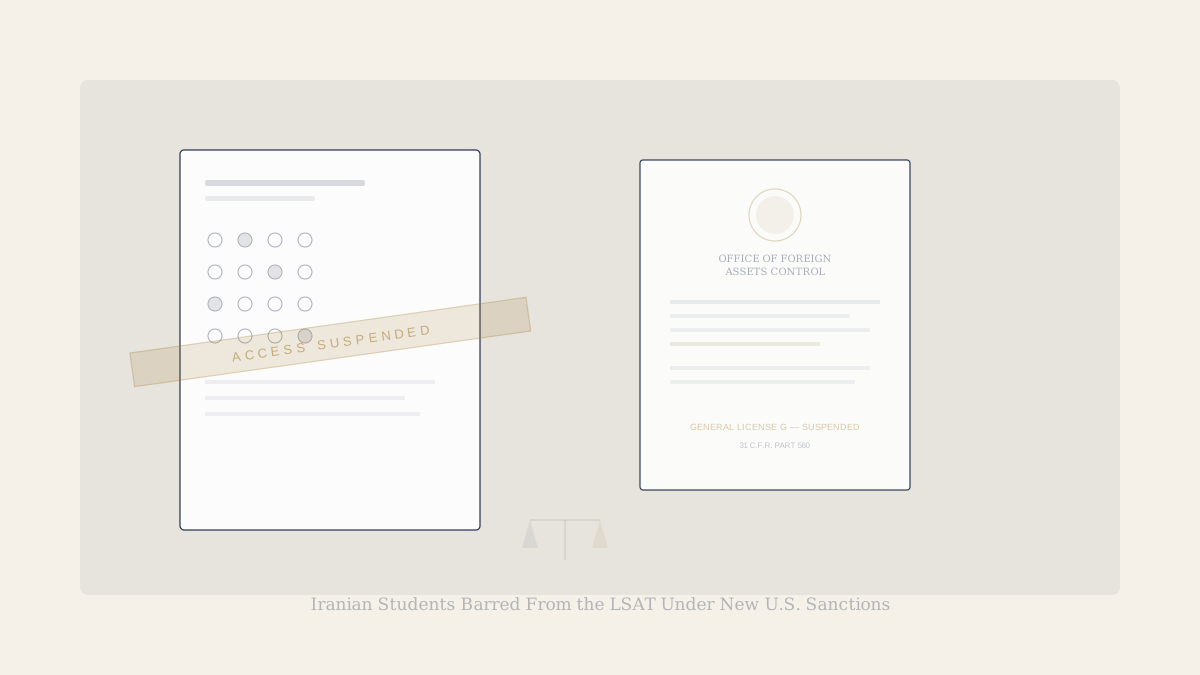
On August 24, 2026, the Treasury Department’s Office of Foreign Assets Control (OFAC) announced that it was indefinitely suspending five general licenses issued under the Iranian Transactions and Sanctions Regulations (ITSR), 31 C.F.R. Part 560 — part of a broader escalation of Iran sanctions the administration has called “Operation Economic Outcast.” Among the suspended authorizations was General License G, which for years had authorized certain academic exchanges and the exportation and importation of certain educational services between the United States and Iran — the legal foundation that allowed U.S. testing organizations and universities to serve Iranian students without individual government approval.
OFAC issued a wind-down authorization — General License BB — that allowed previously authorized educational transactions to be completed through September 8, 2026. After that date, activities that had been covered by the suspended licenses require a specific license: an individual, case-by-case application to OFAC.
LSAC's Response: No Services to Iranian Citizens or Residents
Because LSAC is a U.S. entity subject to the ITSR, it responded to the suspension by cutting off services. LSAC has stated that it can no longer provide any products or services to Iranian citizens or residents — a category that, as applied, includes:
- LSAT registrations — new registrations and, for affected candidates, previously scheduled test dates
- CAS subscriptions — the Credential Assembly Service that nearly all ABA-accredited law schools require for application processing
- Application processing and score reporting — the pipeline through which law school applications actually move
LSAC’s published notice states that restricted persons include those residing in sanctioned jurisdictions and persons designated by the U.S. government as specially designated nationals (SDNs). It has warned that payments attempted by sanctioned individuals may be blocked, and it has encouraged dual citizens and individuals who believe they are exempt to contact LSAC directly.
The practical effect is stark: an Iranian citizen in Tehran planning to sit for the October LSAT, an Iranian student in a third country preparing applications, and — in at least some reported cases — Iranian dual nationals abroad have found themselves locked out of the American legal education pipeline mid-cycle.
Who Is Actually Covered — and the Overcompliance Question
This is where the story becomes legally important for the Iranian-American community, and where affected individuals should not simply accept a denial at face value.
U.S. sanctions on Iran are primarily jurisdictional: they restrict transactions involving Iran, the Government of Iran, and persons ordinarily resident in Iran. They are not, as a general matter, ethnicity- or heritage-based restrictions on U.S. citizens and lawful permanent residents of Iranian descent living in the United States. A green card holder in Queens or a U.S. citizen born in Los Angeles to Iranian parents is a “U.S. person” under the regulations — the very category the ITSR regulates, not the category it targets.
Yet the National Iranian American Council (NIAC) has publicly reported that LSAC’s implementation has reached Iranian-American dual nationals and individuals of Iranian heritage outside Iran, and has sent a letter urging LSAC to reverse course. NIAC’s president called the policy “gratuitous and punitive” and argued that it reflects overcompliance — a company restricting more people than the law requires in order to eliminate its own compliance risk. Overcompliance is a well-documented pattern in sanctions practice: banks, universities, and service providers frequently draw their internal lines wider than the regulations demand, and the people inside that gap lose access to services they are legally entitled to receive.
If you are a U.S. citizen or lawful permanent resident and LSAC has denied you services, that denial deserves scrutiny. Document everything in writing, respond through LSAC’s channel for exempt individuals with proof of your status, and consider having counsel communicate on your behalf before treating the door as closed.
The Legal Machinery: How a General License Suspension Works
Understanding the mechanics helps affected families see where the pressure points are.
General Licenses vs. Specific Licenses
The Iran sanctions program prohibits most transactions between U.S. persons and Iran by default. OFAC then carves back permissions through licenses. A general license is a standing, published authorization — anyone who fits its terms may rely on it without asking. A specific license is an individual authorization granted after a written application under 31 C.F.R. § 501.801.
When OFAC suspended General License G, it did not make educational services categorically illegal — it removed the automatic authorization. Testing organizations, universities, and individuals can still apply for specific licenses. But specific licensing is slow, discretionary, and opaque: applications can take months, there is no deadline by which OFAC must act, and the current policy posture suggests education-related applications will face a hard look. For a student staring at application deadlines this cycle, that timeline is the problem.
Why LSAC Moved So Broadly
Civil penalties under the International Emergency Economic Powers Act (IEEPA) apply on a strict-liability basis — a U.S. organization can be penalized for a prohibited transaction even without intent to violate the law. That risk profile is why service providers tend to overcorrect. It is also why advocacy matters: when organizations hear, clearly and from many voices, that their implementation sweeps in people the law does not restrict, they frequently recalibrate. That is precisely what NIAC’s letter asks LSAC to do.
What Affected Students Can Do Right Now
1. If You Are a U.S. Citizen, Green Card Holder, or Non-Iranian Resident — Assert Your Status
LSAC has expressly invited dual citizens and potentially exempt individuals to contact it. Do so in writing, with documentation of your citizenship or permanent residence, and keep copies of every communication. A denial issued to someone the regulations do not restrict is a compliance error, not a legal requirement.
2. Consider Law Schools That Accept the GRE or Alternative Pathways
A substantial number of ABA-accredited law schools accept the GRE in place of the LSAT, and some participate in JD-Next, an alternative admissions program. The GRE is administered by ETS — a separate organization whose sanctions posture must be evaluated on its own terms — and admission-test policies vary school by school. Affected applicants should check each target school’s current policy and contact admissions offices directly: law schools have discretion in how they treat candidates barred from a test through no fault of their own, and admissions officers cannot exercise that discretion for applicants they never hear from.
3. The Specific License Path
For students with time — for example, those targeting the next admissions cycle — a specific license application to OFAC under 31 C.F.R. § 501.801 is the formal route to restored access. This is specialized sanctions work: the application must be framed correctly, and processing timelines are unpredictable. Yazdi Law can assess your immigration situation and coordinate referrals to dedicated OFAC sanctions counsel where a license application is the right move.
4. Do Not Let the Sanctions Picture Distort Your Immigration Decisions
The LSAT restriction is a sanctions measure, not an immigration action — it does not change anyone’s F-1 status, pending family petition, marriage green card, or naturalization case. But it lands amid a broader tightening that includes the worldwide immigrant visa pause announced in August 2026, enhanced vetting, and 221(g) administrative processing delays that already fall disproportionately on Iranian applicants. Before traveling internationally, moving funds from Iran for tuition or fees, or changing academic plans in ways that touch your status, get advice on the full picture. Decisions that were routine two years ago now carry sanctions and immigration consequences that interact.
What This Moment Means for the Iranian Community in New York
New York is home to one of the largest Iranian-American communities in the country — students at Columbia, NYU, Fordham, Cardozo, and CUNY campuses; professionals across Manhattan; families in Queens, Long Island, and Great Neck. For this community, the LSAT restriction is not an abstraction. It is a nephew in Tehran whose test date evaporated, a daughter with a green card wrongly told she cannot register, a family deciding whether a planned trip abroad is now too risky.
The pattern is familiar to anyone who has practiced immigration law for Iranian clients: policies aimed at the Iranian government consistently land hardest on ordinary Iranians — students, scientists, and families — and on the Iranian-American diaspora that the law does not even purport to restrict. The answer, as it has been through travel bans and visa pauses before, is precision: knowing exactly what the law requires, exactly who it covers, and exactly which doors remain open.
As an Iranian-American attorney — وکیل ایرانی در نیویورک — Amirali Oloomiyazdi founded Yazdi Law to give the Persian community counsel in the language it thinks in. The firm represents Iranian clients across immigration matters in Farsi and English: student status questions, family petitions, marriage green cards for Iranian-American couples, asylum, and naturalization — and helps families understand how the shifting sanctions landscape intersects with their immigration cases.
Contact a Farsi-Speaking Attorney in New York
If you or a family member has been affected by the LSAC restriction, the visa pause, or any of the recent sanctions changes — or if you simply want to understand your options before making a decision about travel, money, or status — Yazdi Law offers free consultations in Farsi and English from our office at 261 Madison Avenue in Midtown Manhattan, two blocks from Grand Central Terminal.
Call (917) 565-7286 or use the form below. We will tell you honestly what falls within our immigration practice, and where a matter requires dedicated OFAC sanctions counsel, we will say so and help you find it.