
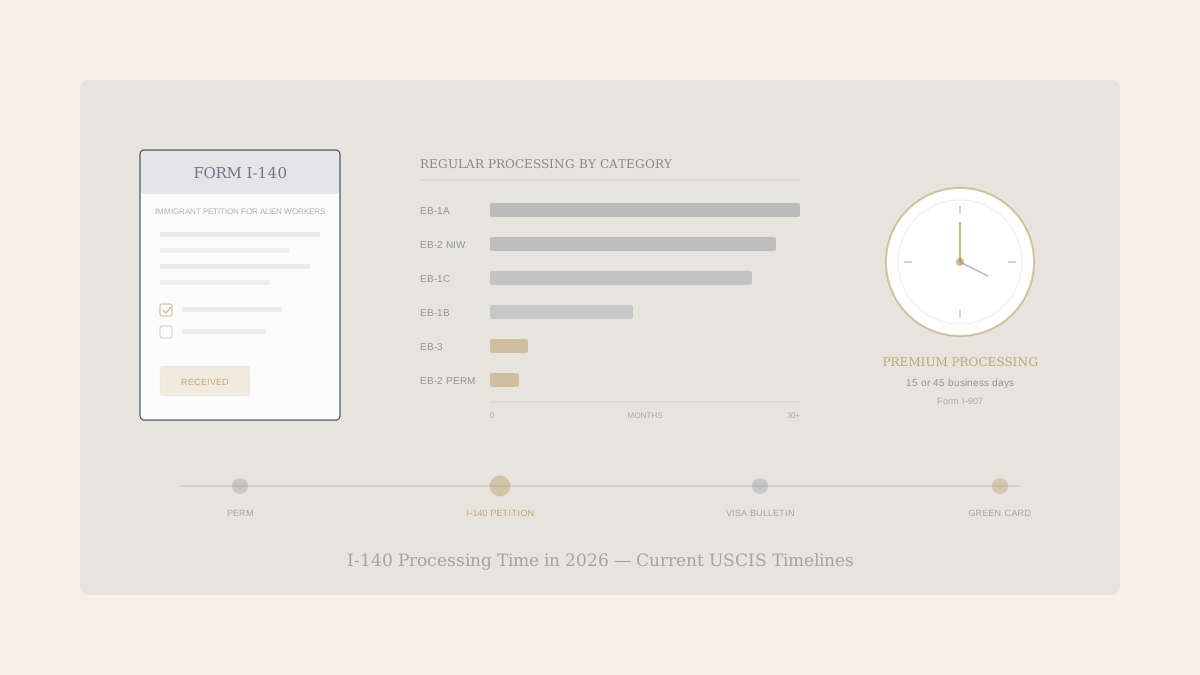
I-140 processing time in 2026 ranges from 15 business days to more than two and a half years, and both figures are accurate. Which one applies to you depends on three things: the green card category your petition is filed in, whether you pay for premium processing, and whether USCIS asks for more evidence along the way. A PERM-based EB-3 petition and a self-petitioned EB-1A are both filed on Form I-140, but they move through USCIS on very different clocks.
This guide sets out the current USCIS timelines for every major I-140 category as of November 2026, explains why the published numbers seem to contradict each other, and covers premium processing, filing fees, the causes of delay, and what happens after an I-140 is approved. It is written for employers sponsoring a worker, professionals in H-1B or O-1 status, and self-petitioners planning an EB-1A or National Interest Waiver case.
How Long Does I-140 Processing Take in 2026?
The table below shows current I-140 processing times by category. The regular processing column reflects the figure USCIS publishes in its processing times tool — the time within which 80% of cases were completed over the prior six months — as reported in early November 2026. The premium column is the guaranteed timeframe when a Form I-907 is filed.
| I-140 category | Regular processing | Premium processing |
|---|---|---|
| EB-1A — Extraordinary ability | About 32.5 months | 15 business days |
| EB-1B — Outstanding professor or researcher | About 15 months | 15 business days |
| EB-1C — Multinational executive or manager | About 27.5 months | 45 business days |
| EB-2 — Advanced degree or exceptional ability (PERM) | About 3 months | 15 business days |
| EB-2 NIW — National Interest Waiver | About 30 months | 45 business days |
| EB-3 — Skilled workers and professionals | About 4 months | 15 business days |
| EB-3 — Other workers | About 9 months | 15 business days |
Three points keep these numbers in perspective. First, they change monthly; always confirm the current figure in the USCIS processing times tool before making a decision that depends on it. Second, they describe only the I-140 stage, which is one of several steps between a job offer and a green card. Third, an approved I-140 does not mean a green card is immediately available — that depends on the Visa Bulletin, discussed below.
What Form I-140 Is and Where It Fits
Form I-140, Immigrant Petition for Alien Workers, is the petition that asks USCIS to classify a foreign national in one of the employment-based immigrant categories created by INA § 203(b). In most cases a U.S. employer files it for a worker; in the EB-1A extraordinary ability and EB-2 National Interest Waiver categories, the individual may self-petition with no employer and no job offer.
The I-140 is the middle step of a three-step process for most employer-sponsored cases:
- PERM labor certification with the Department of Labor (required for most EB-2 and EB-3 cases; not required for EB-1, NIW, or Schedule A occupations)
- Form I-140 with USCIS, which establishes that the beneficiary qualifies for the category and that the employer can pay the offered wage
- Form I-485 adjustment of status in the United States, or consular processing abroad, once a visa number is available
USCIS decides I-140 petitions at its service centers, chiefly the Texas and Nebraska Service Centers. A receipt number beginning with SRC indicates Texas, LIN indicates Nebraska, and IOE indicates a case in USCIS’s electronic system. USCIS now publishes I-140 processing times by category rather than as a single number, which is why the category you file in matters more than the office that receives the file.
I-140 Processing Time by Category
EB-1 Processing Time: EB-1A, EB-1B, and EB-1C
The three EB-1 subcategories under INA § 203(b)(1) have diverged sharply in 2026:
- EB-1A (extraordinary ability): regular processing has lengthened steadily through the year, from roughly 18 months in late 2025 to about 32.5 months by fall 2026. Premium processing remains 15 business days, which is why most EB-1A petitioners use it.
- EB-1B (outstanding professors and researchers): about 15 months with regular processing, an improvement from roughly 18 to 19 months at the start of the year. Premium: 15 business days.
- EB-1C (multinational executives and managers): about 27.5 months with regular processing. Premium processing is available but on the longer 45-business-day track.
EB-1 petitions are evidence-heavy. An EB-1A officer applies the regulatory criteria at 8 C.F.R. § 204.5(h) and then makes a final merits determination; an EB-1C officer examines the corporate relationship and the managerial nature of the role on both sides of the transfer. Our EB-1 visa guide and EB-1A extraordinary ability page cover the requirements in detail.
EB-2 and EB-3 Processing Time for PERM-Based Petitions
Employer-sponsored EB-2 petitions (advanced degree or exceptional ability, INA § 203(b)(2)) and EB-3 petitions (skilled workers, professionals, and other workers, INA § 203(b)(3)) are currently the fastest I-140s at USCIS: about 3 months for EB-2 and about 4 months for EB-3 skilled workers and professionals with regular processing, and about 9 months for EB-3 other workers. Premium processing brings each of them to 15 business days.
They are faster because the Department of Labor has already done much of the work. By the time the I-140 is filed, the labor certification has established the job, the wage, and the absence of available U.S. workers. USCIS is left with two focused questions: does the beneficiary meet the requirements stated on the labor certification, and can the employer pay the proffered wage?
EB-2 NIW Processing Time
National Interest Waiver petitions skip PERM entirely, but the I-140 itself is slow without premium: about 30 months for 80% of cases. Premium processing reduces that to 45 business days, roughly nine weeks. We cover this category in depth, including the Visa Bulletin wait that follows, in our guide to EB-2 NIW processing time in 2026.
Why USCIS’s Median and Its Posted Processing Time Don’t Match
Applicants researching I-140 timelines quickly run into two official-looking numbers that seem irreconcilable. USCIS’s historical processing time data reports a national median of 3.7 months for regular I-140s in fiscal year 2026 (October 1, 2025 through June 30, 2026) — the fastest in several years and roughly half the prior year’s figure. Yet the processing times tool shows 30 months or more for NIW and EB-1A petitions. Both are correct, because they measure different things:
- The median is the point at which half of all completed I-140s, across every category, were decided. PERM-based EB-2 and EB-3 petitions make up most of the volume and move quickly, so they pull the median down.
- The processing times tool shows how long it took to complete 80% of cases in a specific category. It is deliberately conservative, and it isolates the slow categories that the blended median hides.
The practical lesson: a headline that says “I-140s take under four months” is describing an employer-sponsored PERM case. If you are self-petitioning in EB-1A or under a National Interest Waiver, plan around the category-specific figure, not the median.
I-140 Premium Processing in 2026: 15 or 45 Business Days
Premium processing is requested on Form I-907. For an I-140, the fee is $2,965 for requests postmarked on or after March 1, 2026. In exchange, USCIS commits to act within:
- 15 business days for EB-1A, EB-1B, EB-2 petitions not seeking a National Interest Waiver, and EB-3 petitions
- 45 business days for EB-1C multinational executive and manager petitions and EB-2 NIW petitions
The fine print matters as much as the headline number:
- “Action” is not approval. USCIS satisfies the guarantee by issuing an approval, a denial, a Request for Evidence, or a Notice of Intent to Deny.
- An RFE or NOID stops the clock. A new 15- or 45-business-day period begins only when USCIS receives your response.
- The clock starts on proper receipt. A Form I-907 sent with the wrong fee, to the wrong address, or without a valid signature is rejected and starts nothing.
- You can upgrade later. Premium processing can be requested for an I-140 that is already pending under regular processing.
- A missed deadline means a refund. If USCIS does not act in time, it returns the premium fee and continues to process the case on an expedited basis.
Is I-140 Premium Processing Worth It?
For EB-1A, EB-1C, and NIW petitions the difference is measured in years, and a fast decision often has value beyond the petition itself. An approved I-140 can support H-1B extensions past the six-year limit, H-4 spousal work authorization, and the timing of an I-485. For a PERM-based EB-2 or EB-3 petition that would be decided in three or four months anyway, premium is a closer call — usually justified when an H-1B clock is running out, a job change is planned, or a Visa Bulletin date is about to become current.
What premium processing cannot do is improve the petition or shorten a visa backlog. For an India-born EB-2 applicant facing a wait of more than a decade for a visa number, a 15-day I-140 decision still has real uses, but it does not move the green card date.
I-140 Filing Fees in 2026
- Form I-140 filing fee: $715 (a $50 discount generally applies where online filing is available)
- Asylum Program Fee: $600 for regular employers; $300 for small employers with 25 or fewer full-time equivalent employees and for individual self-petitioners; $0 for nonprofits
- Premium processing (optional): $2,965 on Form I-907
In round numbers, an employer-sponsored I-140 costs $1,315 in government fees without premium and $4,280 with it. A self-petitioned EB-1A or NIW costs $1,015 without premium and $3,980 with it. USCIS rejects petitions filed with an incorrect fee, and a rejected filing does not secure a filing date, so confirm the amounts on the current USCIS fee schedule before mailing anything.
What Delays an I-140 — and What Changed in August 2026
Requests for Evidence
An RFE is the most common cause of a long I-140. USCIS may allow up to 84 days to respond, and the case then returns to an officer’s queue. In employer-sponsored cases, RFEs cluster around two issues:
- Ability to pay. Under 8 C.F.R. § 204.5(g)(2), the employer must show it could pay the proffered wage from the priority date forward, using annual reports, federal tax returns, or audited financial statements. Small and newly formed companies, and companies with several pending petitions, draw the most scrutiny.
- Beneficiary qualifications. The beneficiary must have held the required degree and experience as of the priority date. Experience letters that omit dates, hours, or duties, and foreign degrees without a proper credential evaluation, are frequent problems.
In EB-1A and NIW cases, RFEs more often challenge whether the evidence actually satisfies the regulatory criteria or the Matter of Dhanasar framework.
The August 5, 2026 Policy Change: Denial Without an RFE
On August 5, 2026, USCIS updated its Policy Manual to emphasize that officers may deny a filing that lacks required initial evidence without first issuing an RFE or NOID, relying on the discretion already found in 8 C.F.R. § 103.2(b)(8)(ii). Officers may still issue an RFE, and many will, but the default has shifted. For I-140 petitioners this raises the cost of an incomplete filing from a few months’ delay to a possible denial, a new filing fee, and — in categories where the I-140 filing date sets the priority date — a later place in line.
Other Sources of Delay
- Filing without premium processing in a category with a multi-year regular queue
- Rejected filings caused by a wrong fee, an outdated form edition, or a missing signature
- An expiring labor certification: an approved PERM is valid for only 180 days, and the I-140 must be filed within that window (20 C.F.R. § 656.30(b))
- Background and security checks, and policy holds affecting particular nationalities
- Transfers between service centers as USCIS balances workloads
The Full Timeline: From PERM to I-140 to Green Card
The I-140 is rarely the longest part of an employment-based case. A realistic plan accounts for every stage:
- Prevailing wage, recruitment, and PERM (EB-2 and EB-3 only). The Department of Labor stages have commonly taken well over a year before an I-140 can be filed. The date the PERM application is filed becomes the priority date.
- The I-140. Fifteen business days to roughly four months for PERM-based cases; 15 or 45 business days with premium, or well over two years without it, for EB-1A, EB-1C, and NIW. In these no-PERM categories, the priority date is the date USCIS receives the I-140.
- The Visa Bulletin wait. From no wait at all to more than a decade, depending on category and country of birth.
- I-485 or consular processing. USCIS’s reported median for employment-based I-485s in fiscal year 2026 has been roughly six months, though cases that require an interview or extended background checks commonly take a year or more.
What Happens After I-140 Approval
Your Priority Date and the Visa Bulletin
An approved I-140 gives you a confirmed place in line. Whether you can take the final step depends on the Department of State’s monthly Visa Bulletin. Under the November 2026 Visa Bulletin, final action dates stand at:
- EB-1: current for most countries; August 1, 2023 for China; February 1, 2023 for India
- EB-2: April 1, 2025 for most countries (including Iran); October 1, 2021 for China; November 1, 2013 for India
- EB-3: June 15, 2024 for most countries; January 22, 2022 for China; January 22, 2014 for India; August 15, 2023 for the Philippines
Country of birth, not citizenship, determines which column applies. For November 2026, USCIS is accepting employment-based I-485 filings under the more generous Dates for Filing chart, which lists March 15, 2026 for EB-2 and August 1, 2024 for EB-3 for most countries.
I-485 Adjustment of Status or Consular Processing
If you are in the United States and a visa number is available, you file Form I-485 — concurrently with the I-140 if your date is already current. A pending I-485 allows you to apply for an employment authorization document and advance parole. If you are abroad, the case moves through the National Visa Center to an immigrant visa interview at a U.S. consulate. Our guide to navigating USCIS explains the filings common to both paths.
One caution for applicants abroad: the State Department’s worldwide pause on immigrant visa interviews, which began in August 2026, was still reported to be in effect in early November 2026 with no restart date announced. Applicants who are lawfully in the United States and eligible to adjust status are not directly affected by that pause, which makes the choice between adjustment and consular processing more consequential than usual.
Benefits of an Approved I-140 While You Wait
- H-1B extensions beyond six years. Under AC21 § 104(c), a worker with an approved I-140 who cannot file an I-485 because of per-country limits can extend H-1B status in three-year increments. Under § 106(a), one-year extensions are available once a PERM or I-140 has been pending for 365 days.
- H-4 spousal work authorization. The spouse of an H-1B worker with an approved I-140 may qualify for an H-4 EAD under 8 C.F.R. § 214.2(h)(9)(iv).
- Priority date retention. Under 8 C.F.R. § 204.5(e), the priority date of an approved I-140 carries over to a later petition in EB-1, EB-2, or EB-3, unless the approval was revoked for fraud, misrepresentation, material error, or invalidation of the labor certification.
- Protection after 180 days. Once an I-140 has been approved for 180 days, an employer’s withdrawal or closure generally does not automatically revoke it (8 C.F.R. § 205.1(a)(3)(iii)).
- Job portability. After an I-485 has been pending 180 days, INA § 204(j) permits a move to a job in the same or a similar occupational classification.
What an approved I-140 does not provide is equally important: it confers no lawful status and no work authorization of its own. Your underlying status — H-1B, L-1, O-1, or F-1 OPT — must be maintained until an I-485 is filed.
How to Check Your I-140 Status and What to Do About a Delay
- Check Case Status Online at uscis.gov using the receipt number from your Form I-797 notice. In employer-sponsored cases the petitioner, not the beneficiary, is the party USCIS communicates with.
- Compare against the processing times tool. Select Form I-140 and your category. The tool displays the date before which a case is considered outside normal processing time.
- Submit a case inquiry once your receipt date is earlier than that date.
- Upgrade to premium processing. For most long-pending I-140s this is the most direct remedy.
- Request an expedite only if you meet USCIS’s criteria — severe financial loss, urgent humanitarian need, a qualifying nonprofit or government interest, or clear USCIS error. USCIS generally expects premium-eligible petitioners to use premium instead.
- Consider federal court. Where a petition has been pending far beyond posted times without explanation, a suit under the Administrative Procedure Act (5 U.S.C. § 706(1)) and the Mandamus Act (28 U.S.C. § 1361) asks a federal judge to order USCIS to decide the case. For New York petitioners these actions are typically filed in the Southern or Eastern District of New York. A court can compel a decision; it cannot compel an approval.
I-140 Petitions for Iranian Professionals
Yazdi Law represents many Iranian and Iranian-American clients, and several I-140 issues arise in their cases with particular frequency:
- Visa availability is comparatively favorable. Applicants born in Iran fall under the “all chargeability areas” column of the Visa Bulletin, where EB-1 is current and EB-2 and EB-3 waits are far shorter than those facing India- and China-born applicants.
- Documents require preparation. Iranian university degrees, transcripts, and employment letters need certified English translations and credential evaluations, and obtaining originals from Iran takes time. This work should begin before the petition is drafted, not after an RFE arrives.
- Consular processing is harder. With no U.S. embassy in Tehran, Iranian applicants interview in third countries such as Abu Dhabi, Ankara, or Yerevan, and administrative processing under INA § 221(g) frequently adds months. The current immigrant visa interview pause and entry restrictions affecting Iranian nationals add further uncertainty for applicants abroad.
- Policy holds may apply. In 2026, USCIS directed that certain pending benefit requests involving nationals of countries covered by the expanded travel restrictions, including Iran, be held for additional review. That policy has been modified and challenged in federal court, and its reach has changed over the year. An Iranian-born beneficiary should not assume that a posted processing time will apply to their case without confirming the current rules.
For Iranian professionals already in the United States, these factors generally favor filing early, maintaining status carefully, and adjusting status domestically where eligible. Consultations are available in Farsi.
Six Ways to Keep Your I-140 on the Fastest Track
- Choose the category deliberately. EB-2 versus EB-3, PERM versus NIW, and NIW versus EB-1A each carry different I-140 timelines and different Visa Bulletin waits. The fastest petition is not always the fastest green card.
- File a complete petition the first time. After the August 2026 policy change, missing initial evidence can mean a denial rather than an RFE.
- Document ability to pay before filing. Employers should confirm that tax returns or audited financials support the offered wage from the priority date.
- Match the experience letters to the labor certification. Dates, job titles, hours, and duties must line up with what the PERM required.
- Use premium processing where the gap is large. In EB-1A, EB-1C, and NIW cases, the fee replaces a wait of two years or more.
- Plan the step after approval now. Track both Visa Bulletin charts, prepare I-485 documents and the medical examination in advance, and keep your nonimmigrant status valid throughout.
Talk to a New York Immigration Attorney About Your I-140
An I-140 consultation should answer three questions: which category fits your record, how long your case is likely to take given your country of birth and current status, and what must be in the petition to avoid a preventable RFE or denial. Yazdi Law, PLLC prepares employer-sponsored and self-petitioned I-140s — including EB-1A and EB-2 NIW petitions — alongside the H-1B and O-1 filings that keep clients in status while a green card case is pending. Because immigration law is federal, we represent employers and professionals in New York City, Long Island, and throughout the United States from our office at 261 Madison Avenue in Midtown Manhattan. Consultations are available in English, Farsi, and Punjabi.
Call (917) 565-7286 or use the form below to discuss your I-140 timeline with an immigration attorney.